Habil & Qabil هابيل وقابيل/ Abel & Cain Mentioned in Quran or Hadith
Habil and Qabil were the sons of Prophet Adam. Qabil's jealousy led him to murder Habil out of envy for Allah's acceptance of Habil's sacrifice, marking the first act of murder in human history.
Habil & Qabil هابيل وقابيل/ Abel & Cain Mentioned in Quran or Hadith
Habil and Qabil were the sons of Prophet Adam. Qabil's jealousy led him to murder Habil out of envy for Allah's acceptance of Habil's sacrifice, marking the first act of murder in human history.
The son of Prophet Adam عليه السلام and his successor to prophethood. Sheeth عليه السلام is recognised for his righteousness and role in preserving the teachings of his father.
Sheeth شيث/ Seth Prophet
The son of Prophet Adam عليه السلام and his successor to prophethood. Sheeth عليه السلام is recognised for his righteousness and role in preserving the teachings of his father.
Enos أنوش/ Enos Prophet
The son of Prophet Seeth and the grandson of Prophet Adam. Enos عليه السلام continued the legacy of his forefathers, preaching monotheism and righteousness to his people.
Enos أنوش/ Enos Prophet
The son of Prophet Seeth and the grandson of Prophet Adam. Enos عليه السلام continued the legacy of his forefathers, preaching monotheism and righteousness to his people.
Kenan كِنَاْنْ/ Cainan Prophet
Mahalalil مهلالئيل/ Mahalalel Prophet
Mahalalil عليه السلام is the son of Kenan (Cainan) and the father of Yared (Jared).
Mahalalil مهلالئيل/ Mahalalel Prophet
Mahalalil عليه السلام is the son of Kenan (Cainan) and the father of Yared (Jared).
Yared يارد/ Jared Prophet
Idris إدريس/ Enoch Prophet
Idris عليه السلام was a prophet and messenger of Allah, known for his righteousness and knowledge.
Idris إدريس/ Enoch Prophet
Idris عليه السلام was a prophet and messenger of Allah, known for his righteousness and knowledge.
Adam عليه السلام died 308 years after the birth of Idris.
Adam's Death
Adam عليه السلام died 308 years after the birth of Idris, marking the end of the first human and prophet's earthly life.
Nuh نوح/ Noah Prophet
First Messenger to Mankind
Nuh عليه السلام, the first messenger sent to mankind, was commanded by Allah to call the people back to righteousness. With steadfastness and resilience, he called his people for 950 years, employing various methods to abandon shirk and return to Tawheed.
Nuh عليه السلام, the first messenger sent to mankind, was commanded by Allah to call the people back to righteousness. With steadfastness and resilience, he called his people for 950 years, employing various methods to abandon shirk and return to Tawheed.
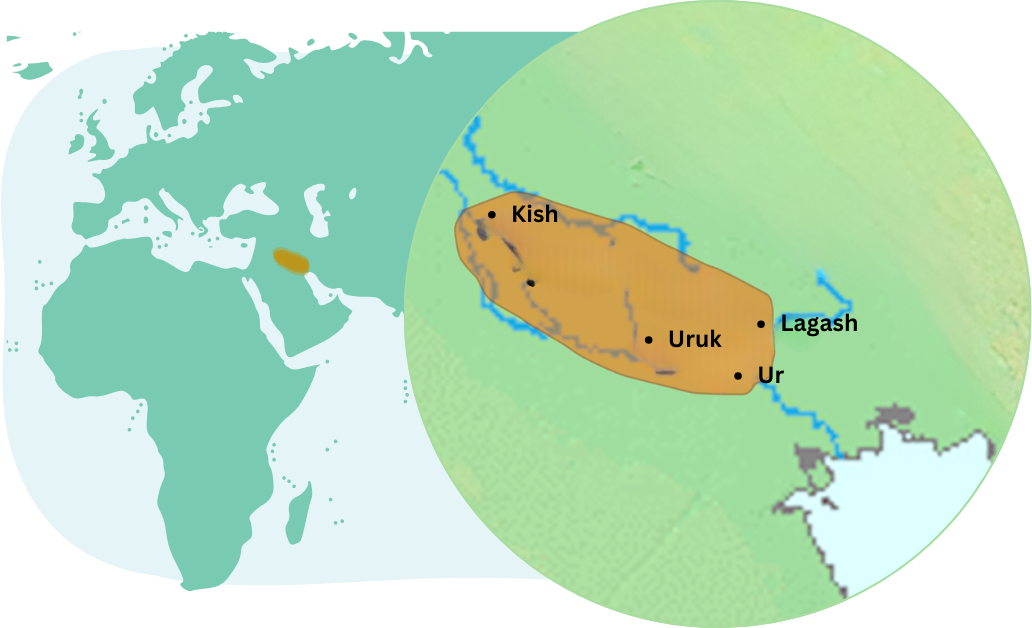
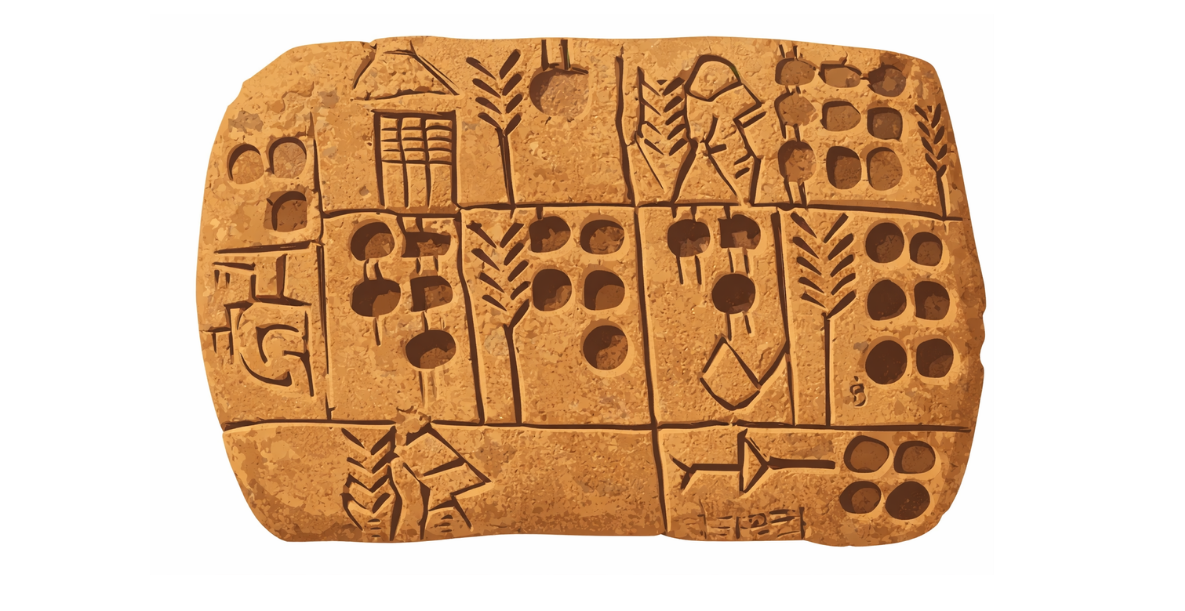
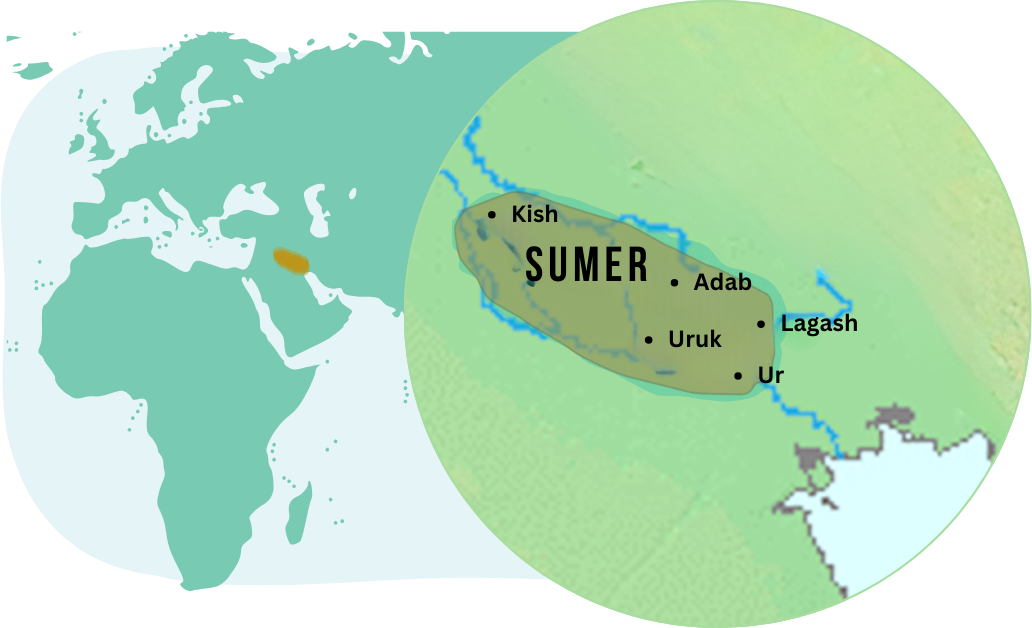
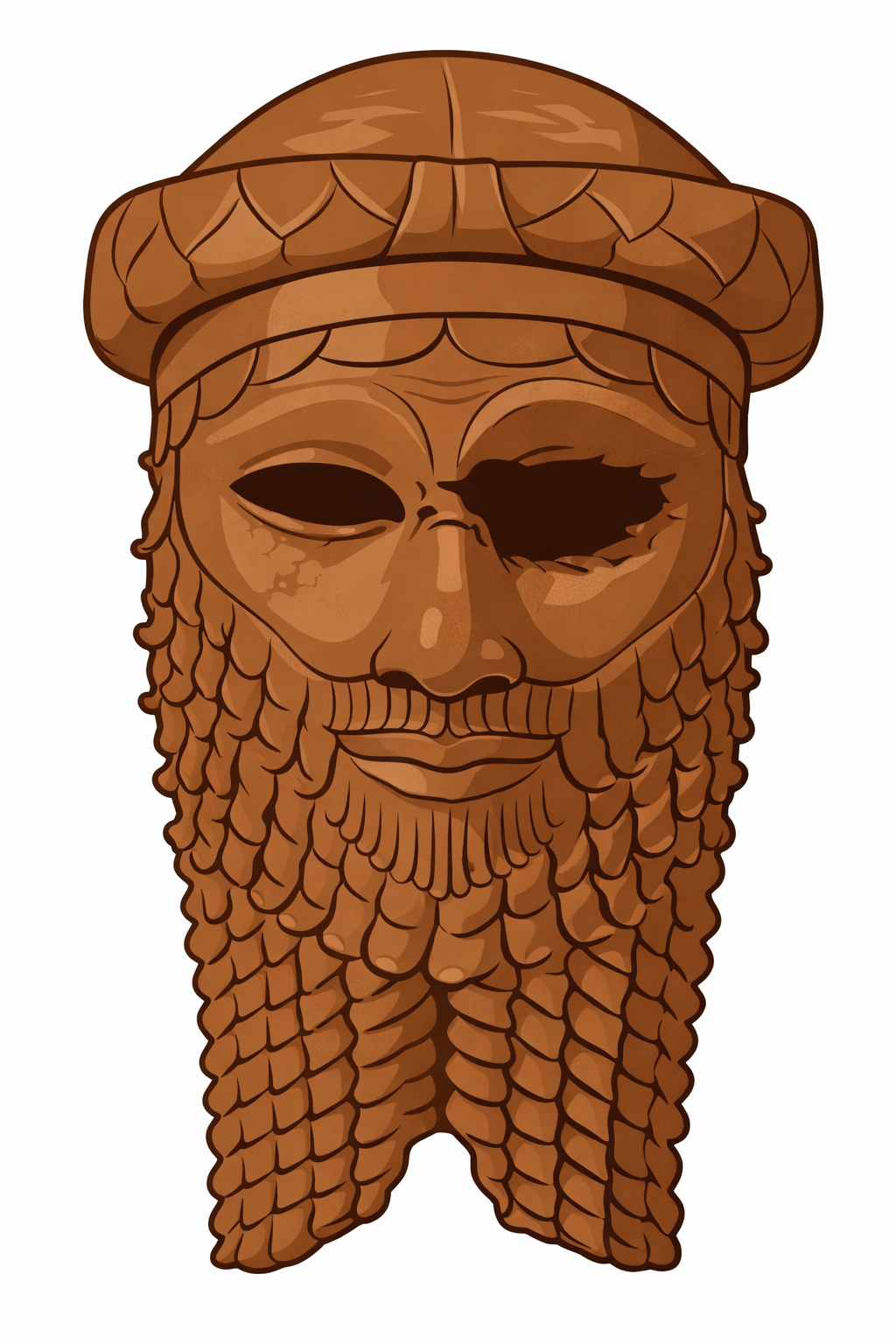
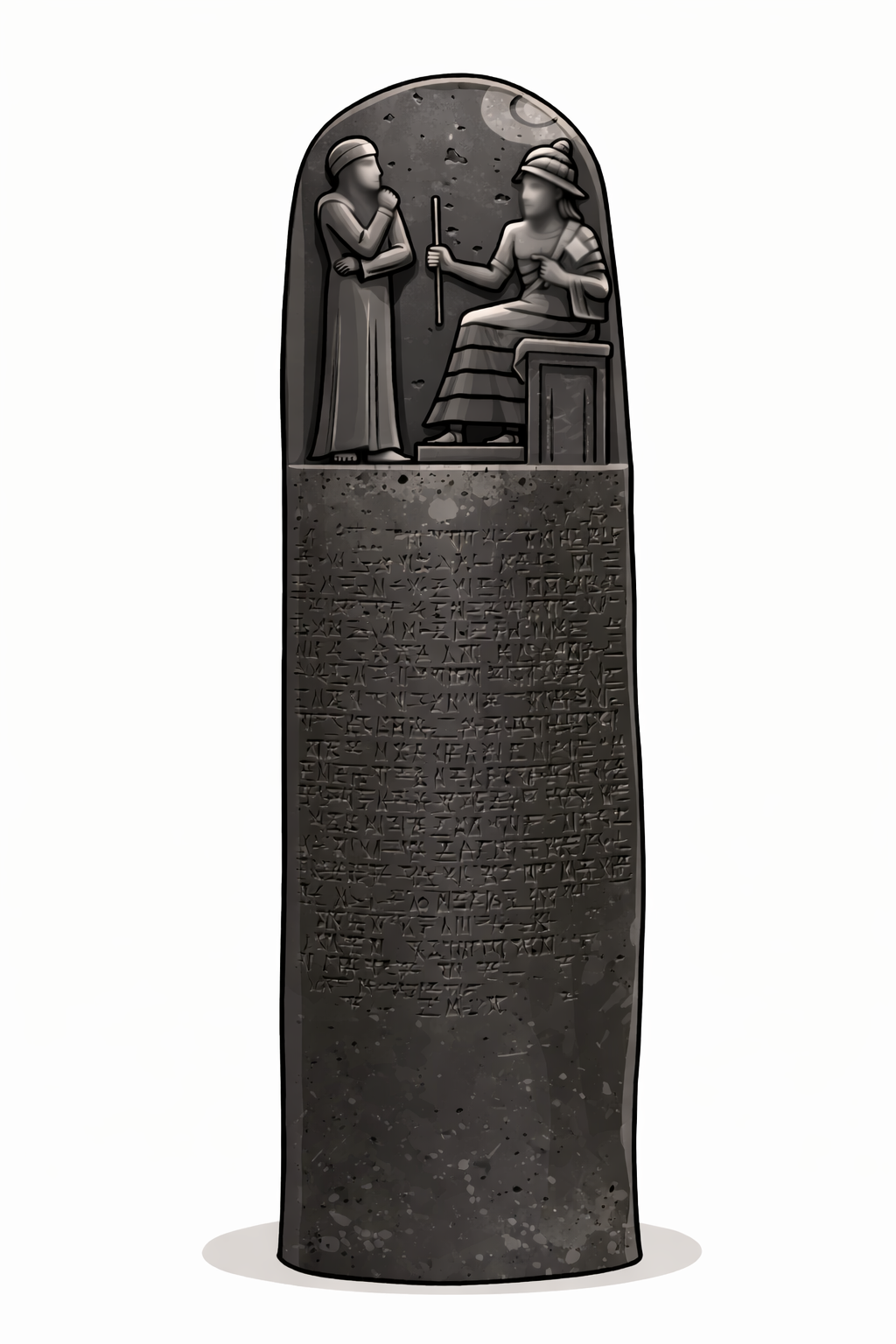
c.2600 BCE King Sargon of Akkad unites Sumerian cities to create the world's first empire invention Explore Mesopotamia +
ⓘ
Hud هود/ Herber Prophet
Prophet Hud عليه السلام was sent to the tribe of Ad to call them to worship Allah alone and abandon idols. Despite his warnings about the Day of Judgement and calls for repentance, they mocked him and remained arrogant. Trusting their wealth, they rejected his message. Allah then destroyed them with a violent windstorm, saving only Hud and the believers.
Prophet Hud عليه السلام was sent to the tribe of Ad to call them to worship Allah alone and abandon idols. Despite his warnings about the Day of Judgement and calls for repentance, they mocked him and remained arrogant. Trusting their wealth, they rejected his message. Allah then destroyed them with a violent windstorm, saving only Hud and the believers.
2000 BCE Bronze casting is practised by the Erlitu culture on the Yellow River Invention Explore Bronze Age China +
ⓘ
Allah sent Prophet Salih عليه السلام to guide the people of Thamud. The people of Thamud demanded Prophet Salih show a miracle, and Allah sent a miraculous she-camel from a rock. They rejected it and killed the camel despite warnings. Ignoring calls to repent, Thamud faced destruction by a devastating blast and earthquake.
Allah sent Prophet Salih عليه السلام to guide the people of Thamud. The people of Thamud demanded Prophet Salih show a miracle, and Allah sent a miraculous she-camel from a rock. They rejected it and killed the camel despite warnings. Ignoring calls to repent, Thamud faced destruction by a devastating blast and earthquake.
1900 BCE Construction of the Temple of Karnak at Thebes in Egypt begins Culture
ⓘ
1900 BCE Construction of the Temple of Karnak at Thebes in Egypt begins Culture
ⓘ
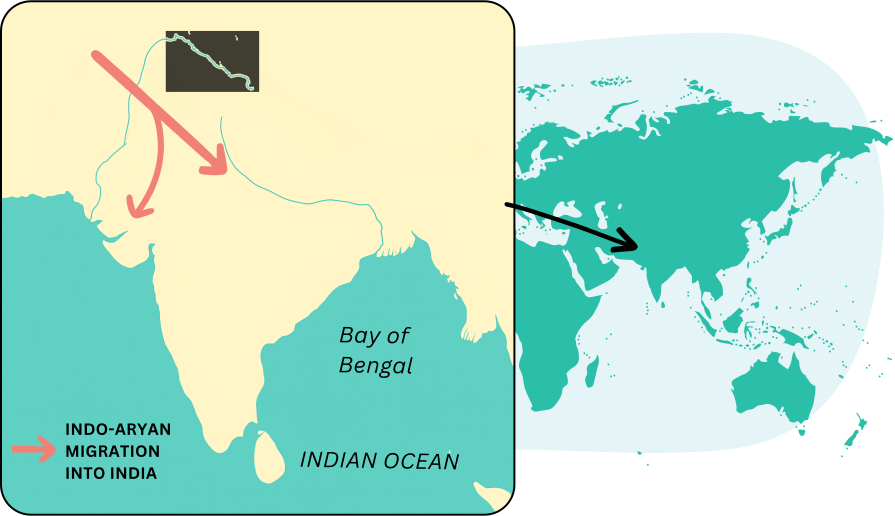
1800 BCE Climate change begins to affect the Indus Valley region Environment
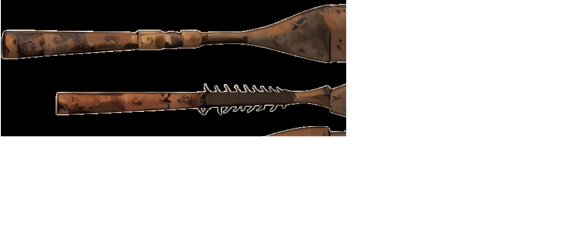
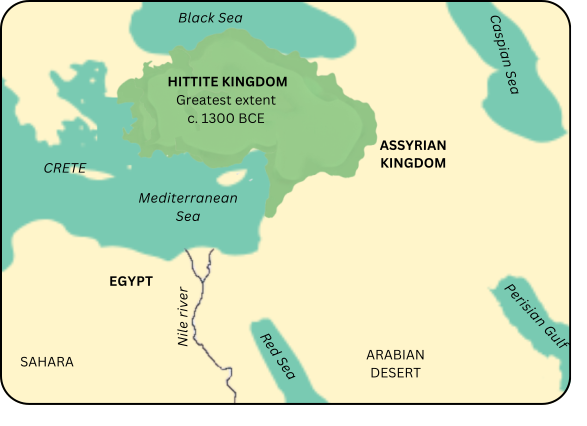
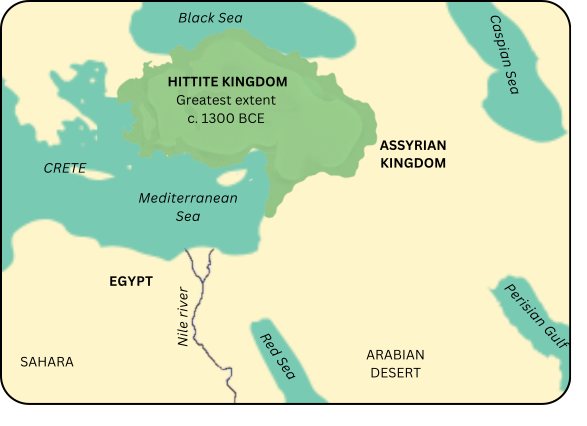
1800-1700 BCE The Hittites (in the region Asia Minor; modern-day Turkey) begin working with iron, and by around 1500 BCE, pioneering large-scale iron smelting and forging, sparking the Iron Age. Technology Explore the Iron Age +
ⓘ
1800-1700 BCE The Hittites (in the region Asia Minor; modern-day Turkey) begin working with iron, and by around 1500 BCE, pioneering large-scale iron smelting and forging, sparking the Iron Age. Technology Explore the Iron Age +
ⓘ
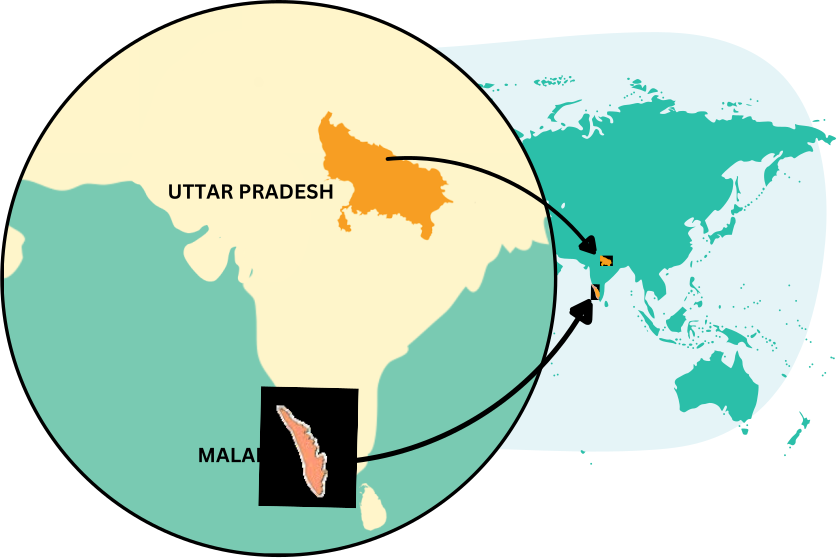
1800 BCE Iron objects are produced in the regions of Uttar Pradesh and Malabar in India Technology Explore the Iron Age +
Prophet Ibrahim عليه السلام challenged the prevalent polytheistic beliefs of his society and endured numerous trials and tests throughout his life, including facing persecution from his own family and community, being thrown into a fire, and being commanded to sacrifice his son.
Prophet Ibrahim عليه السلام challenged the prevalent polytheistic beliefs of his society and endured numerous trials and tests throughout his life, including facing persecution from his own family and community, being thrown into a fire, and being commanded to sacrifice his son.
Prophet Lut عليه السلام was sent to guide the people of Sodom and Gomorrah. He warned them of divine punishment for their transgressions, ultimately witnessing their destruction as a consequence of their refusal to repent.
Prophet Lut عليه السلام was sent to guide the people of Sodom and Gomorrah. He warned them of divine punishment for their transgressions, ultimately witnessing their destruction as a consequence of their refusal to repent.
Prophet Ismail عليه السلام is the son of Prophet Ibrahim and Hagar. Isma'il عليه السلام built the Kaaba with his father, in Mecca, as a sanctuary for monotheistic worship.
Prophet Ismail عليه السلام is the son of Prophet Ibrahim and Hagar. Isma'il عليه السلام built the Kaaba with his father, in Mecca, as a sanctuary for monotheistic worship.
Prophet Yaqoub عليه السلام persevered through familial trials, including the loss of his son Yusuf, ultimately reuniting with him and exemplifying patience and trust in Allah.
Prophet Yaqoub عليه السلام persevered through familial trials, including the loss of his son Yusuf, ultimately reuniting with him and exemplifying patience and trust in Allah.
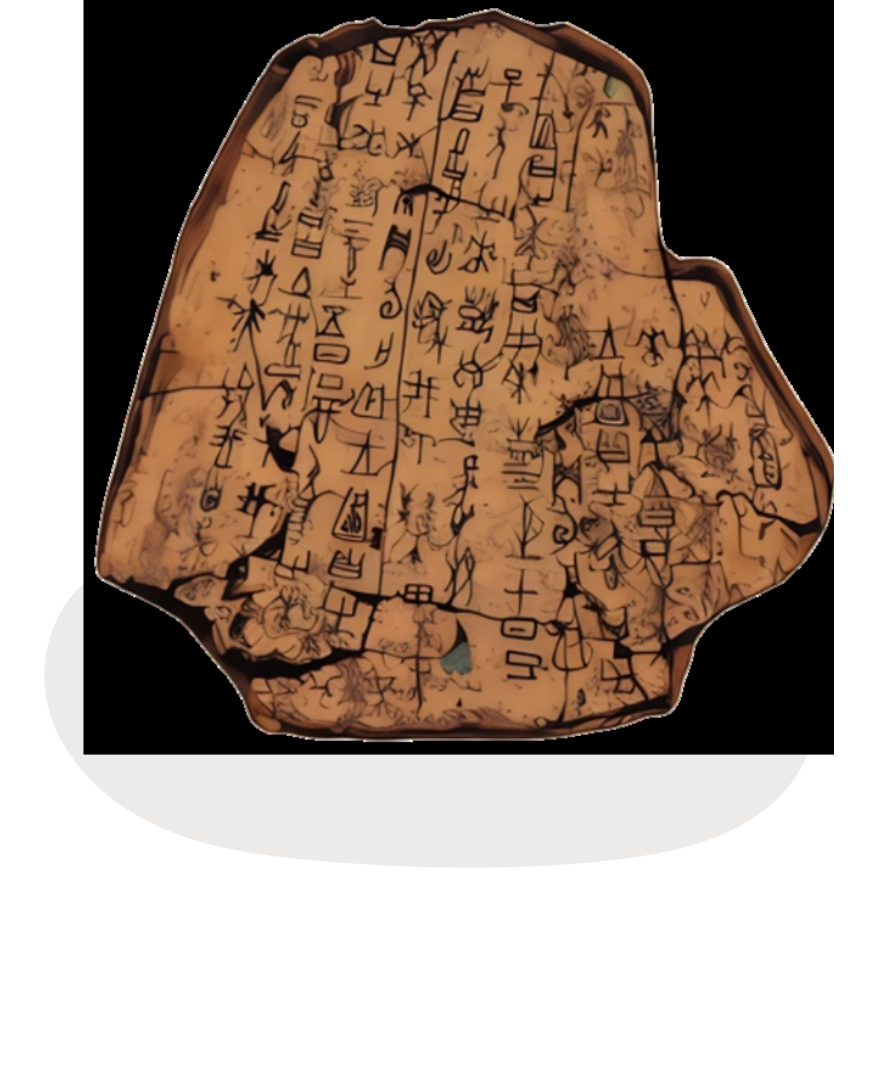
1300 BCE Evidence from bone inscriptions shows that the Shang dynasty Chinese had established the solar year at 365.25 days and lunar month at 29.5 days. Science
1300 BCE Evidence from bone inscriptions shows that the Shang dynasty Chinese had established the solar year at 365.25 days and lunar month at 29.5 days. Science
1200 BCE The Hittite Empire (in the region Asia Minor; modern-day Turkey) collapses. The Assyrians begin employing iron for weapons and armor Civilisation Explore Collapse of the Bronze Age +
ⓘ
1200 BCE The Hittite Empire (in the region Asia Minor; modern-day Turkey) collapses. The Assyrians begin employing iron for weapons and armor Civilisation Explore Collapse of the Bronze Age +
ⓘ
1200 BCE Ironworking spreads across the Eastern Mediterranean Technology Explore the Iron Age +
1200 BCE Ironworking spreads across the Eastern Mediterranean Technology Explore the Iron Age +
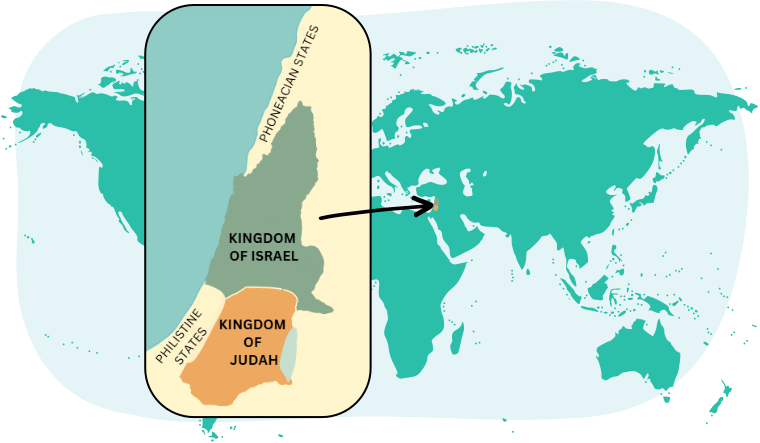
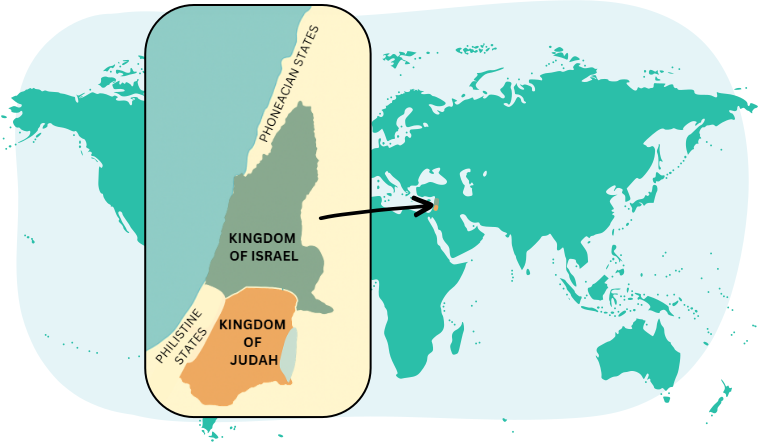
1020 BCE Kingdom of Israel created, founded by Saul. Kingdom reaches its greatest height under Prophet Dawud عليه السلام, but splits into Israel and Judah in 926 BCE. Culture Explore Ancient Levant +
1020 BCE Kingdom of Israel created, founded by Saul. Kingdom reaches its greatest height under Prophet Dawud عليه السلام, but splits into Israel and Judah in 926 BCE. Culture Explore Ancient Levant +
776 BCE The first pan-Hellenic games are held at Olympia in Greece Culture
700-338 BCE Ancient Greece is composed of hundreds of city states, many which were rivals, the biggest of these were Athens and Sparta. Explore the Greek City States +
700-338 BCE Ancient Greece is composed of hundreds of city states, many which were rivals, the biggest of these were Athens and Sparta. Explore the Greek City States +
336 BCE Alexander III ascends to the throne to become King of Macedonia at the age of 21. Within 10 years, he conquered the Persian Empire, creating an empire that spanned from Greece to India Civilisation Explore Alexander the Great +
264 - 146 BCE The Punic Wars. A series of three wars with the Carthaginians which took place over a century, ended with victory for the Roman Republic. Politics and War Explore The Punic Wars +
264 - 146 BCE The Punic Wars. A series of three wars with the Carthaginians which took place over a century, ended with victory for the Roman Republic. Politics and War Explore The Punic Wars +
c. 250 BCE Archimedes formulates principles of levers, pulleys, and hydrostatics Science
221 BCE Qin leader Ying Zheng takes the title Qin Shi Huang, becoming the First Emperor of China Civilisation Explore China's First Emperor +
221 BCE Qin leader Ying Zheng takes the title Qin Shi Huang, becoming the First Emperor of China Civilisation Explore China's First Emperor +
206 BCE The Han Dynasty is founded in China, ushering in centuries of stability and expansion Civilisation Explore the Han Empire +
49 BCE Julius Caesar (assassinated in 44 BCE) seizes power as dictator and sets Rome on a path from republic to empire. Politics and War Explore the Roman Empire +
31 BCE Octavian defeats Antony and Cleopatra at Actium; he becomes sole ruler of Rome Politics and War Explore the Roman Empire +
31 BCE Octavian defeats Antony and Cleopatra at Actium; he becomes sole ruler of Rome Politics and War Explore the Roman Empire +
27 BCE The Senate grants Octavian the title Augustus, he becomes the first emperor, marking the official beginning of the Roman Empire. Civilisation Explore the Roman Empire +
79 CE Mount Vesuvius erupts, causing the Roman city Pompeii to become entombed Environment
80 CE The Colosseum is built in Rome civilisation
80 CE The Colosseum is built in Rome civilisation
2ND CENTURY CE
100–c.715 CE The Empire of Aksum, centred in modern-day Ethiopia and Eritrea, becomes a powerful Red Sea trading hub linking Africa, Arabia, and the Mediterranean Civilisation
100–c.715 CE The Empire of Aksum, centred in modern-day Ethiopia and Eritrea, becomes a powerful Red Sea trading hub linking Africa, Arabia, and the Mediterranean Civilisation
330 CE Emperor Constantine moves the Roman capital from Rome to Byzantium (later renamed Constantinople, modern-day Istanbul) Civilisation
395 CE The Roman Empire is formally divided into Western and Eastern halves. The Western Empire collapses in 476, while the Eastern Empire (Byzantium) endures for another thousand years Civilisation Explore the Byzantine Empire +
395 CE The Roman Empire is formally divided into Western and Eastern halves. The Western Empire collapses in 476, while the Eastern Empire (Byzantium) endures for another thousand years Civilisation Explore the Byzantine Empire +
429 CE Roman North Africa is invaded by the Vandals; their kingdom ends with an Eastern Roman reconquest in 533 Politics and War Explore the Roman Empire +
429 CE Roman North Africa is invaded by the Vandals; their kingdom ends with an Eastern Roman reconquest in 533 Politics and War Explore the Roman Empire +
456 CE Visigoths under Theoderic II control Spain apart from Suevic kingdom politics and war
456 CE Visigoths under Theoderic II control Spain apart from Suevic kingdom politics and war
476 CE The last Western Roman emperor, Romulus Augustulus, is deposed by his army chief, Odovacer Politics and War Explore The Roman Empire +
500–1200 CE The Kingdom of Ghana dominates West Africa, thriving on trans-Saharan trade in gold, salt, and ivory before its decline with the rise of Mali Civilisation
500–1500 CE Christian kingdoms of Nubia flourish along the Nile south of Egypt until their decline in the late Middle Ages Civilisation
500–1500 CE Christian kingdoms of Nubia flourish along the Nile south of Egypt until their decline in the late Middle Ages Civilisation
506 CE Visigothic king Alaric II issues the Breviarium, a Roman-style law code civilisation
511-561 CE Frankish kingdom divided into four after the death of Clovis. Partitioned again in 561. Weakening the rule of the Franks politics and war
511-561 CE Frankish kingdom divided into four after the death of Clovis. Partitioned again in 561. Weakening the rule of the Franks politics and war
533-535 CE Byzantine emperor Justinian launches a war to reconquer North Africa and Italy from Germanic kings Politics and War Explore The Byzantine Empire +
534 CE Eastern Roman general Belisarius invades Sicily, beginning the reconquest of Italy politics and war
534 CE Eastern Roman general Belisarius invades Sicily, beginning the reconquest of Italy politics and war
From the second generation of Muslims; one of the young but eminent Sahabah.
FROM: MECCA
Born to ʿAbbas ibn ʿAbd al-Muṭṭalib, the Prophet’s ﷺ uncle.
KNOWN FOR:
• Known as “Hibr al-Ummah” (Scholar of the Ummah) • “Tarjuman al-Qur'an” (Interpreter of the Qur’an) • Famous for profound Tafsīr knowledge and deep understanding of the Qur'an
STUDENT OF:
The Prophet Muhammad ﷺ, who made duʿāʾ for him: “O Allah, give him knowledge of the religion and understanding of Tafsīr.”
BOOKS
No authored works; known for transmitted Tafsīr, narrations, and teachings preserved in major collections.
INTERESTING FACTS
He was personally taught by the Prophet ﷺ, who prayed for his knowledge and understanding of the Qur’an.
Despite his youth, he was included in high-level discussions during the caliphate of ʿUmar ibn al-Khaṭṭāb رضي الله عنه.
BRIEF BIO:
ʿAbdullah Ibn ʿAbbas (رضي الله عنهما) was a close companion of the Prophet ﷺ whose understanding of the Qur’an shaped Islamic scholarship. The Prophet’s duʿāʾ for him to gain deep insight was fulfilled as he became known as “Hibr al-Ummah” and “Tarjuman al-Qur’an.”
During the caliphate of ʿUmar, he displayed exceptional Tafsīr skill—famously interpreting Surah al-Naṣr as a sign of the Prophet’s ﷺ nearing death.
Ibn ʿAbbas’s contributions in Tafsīr and Hadith remain foundational, influencing generations of scholars.
Abdullah ibn Masud (رضي الله عنه)
NAMES
Abdullah ibn Masʿūd ibn Ghafil ibn Habīb ibn Shamakh ibn Saʿir ibn Mazhum ibn Sahil ibn Kahil ibn Tamim ibn Saʿid ibn Hudhayl ibn Muḍrika ibn Yas ibn Mudar (رضي الله عنه)
LIVED: 1ST CENTURY
Exact dates not stated in all sources, but he lived during the earliest period of Islam.
Among the first generation of Muslims (Sahabah).
FROM:
Belonged to the tribe of Hudhayl, a noble Arab tribe renowned for bravery, eloquence, and poetry.
KNOWN FOR:
• One of the foremost scholars among the Sahabah • Famous for his deep knowledge of the Qur'an, precise recitation, and understanding of Islamic law • Memorised the Qur’an during the Prophet’s ﷺ lifetime • Narrated many hadiths and shaped early Islamic scholarship • Known for humility, piety, and strict adherence to the Sunnah • Among the earliest Muslims to openly recite the Qur’an in Mecca despite persecution
STUDENT OF:
The Prophet Muhammad ﷺ, from whom he learned the Qur’an, its meanings, and its application directly.
BOOKS
No authored works, but his teachings are preserved extensively in books of Hadith and Tafsīr.
INTERESTING FACTS
He memorised the entire Qur’an during the lifetime of the Prophet ﷺ.
His tribe, Hudhayl, was famed for bravery and eloquence even before Islam.
He was among the earliest people to witness and support the Prophet ﷺ in Mecca.
He described seeing the Prophet ﷺ as radiant and dignified during an early trade journey.
He said he was the “sixth of six” Muslims when Islam was still in its earliest days.
He warned about showing off in worship, saying that acts are nullified by the desire to be praised.
The Prophet ﷺ personally gave him his kunya “Ibn Umm ʿAbd.”
He was the first companion to publicly recite the Qur’an where non-Muslims could hear.
BRIEF BIO:
ʿAbdullāh ibn Masʿūd (رضي الله عنه) was among the earliest converts to Islam—some narrations state he was the twenty-third Muslim. His first encounter with the Prophet ﷺ was as a shepherd, when he witnessed the miracle of milk flowing from a barren sheep. This event led to his embracing Islam.
He became one of the closest companions of the Prophet ﷺ, known especially for his mastery of the Qur’an. The Prophet ﷺ said, “Whoever wants to recite the Qur’an as fresh as it was revealed, let him recite according to the recitation of Ibn Umm ʿAbd.”
ʿUmar ibn al-Khaṭṭāb رضي الله عنه appointed him as a teacher and leader in Kūfah, where he trained a generation of scholars. His teachings in fiqh, ʿaqīdah, and manhaj deeply shaped early Islamic learning.
Though small in stature, he was courageous and devout, known for humility and sincerity. He said, “If you knew my sins, none of you would walk behind me.” His legacy remains one of knowledge, devotion, and steadfastness in the service of the Qur’an and the Sunnah.
Sa'd ibn Abi Waqqas (رضي الله عنه)
NAMES
Sa'd ibn Abi Waqqas ibn Malik az-Zuhri (رضي الله عنه)
LIVED: 1ST CENTURY
Died 55 AH / 675 CE (birth date not recorded)
Among the first generation of Muslims (Sahabah) and among the earliest converts to Islam.
FROM:
Born in Mecca; later migrated to Medina.
LINEAGE / TRIBE
From the Zuhrah clan of Quraysh, a noble family. Related to the Prophet ﷺ through his mother, making him a close relative.
KNOWN FOR:
• One of the ten companions promised Paradise (Asharah Mubasharah) • First Muslim to shoot an arrow in the cause of Allah • Master archer, courageous warrior, and early convert to Islam • Participated in major battles: Badr, Uhud, and Qadisiyyah • Renowned leader, statesman, and man of deep piety
STUDENT OF:
The Prophet Muhammad ﷺ, from whom he learned directly.
BOOKS
No authored works. His sayings and narrations are widely preserved in Hadith collections and historical literature.
INTERESTING FACTS
He was the first Muslim to shoot an arrow in the path of Allah.
One of the ten companions promised Paradise by name.
The Prophet ﷺ said to him at Uhud, “Shoot, O Sa'd! May my parents be ransomed for you.”
His mother opposed his Islam, but he remained steadfast in faith.
He led the Muslim army at Qadisiyyah, achieving a defining victory over the Persians.
BRIEF BIO:
Sa'd ibn Abi Waqqas (رضي الله عنه) embraced Islam at the age of 17 and was among the earliest believers. Coming from a noble branch of Quraysh, he endured hardship for his faith but remained unwavering.
His skill in archery made him a valuable warrior, and the Prophet ﷺ honored him uniquely at Uhud, saying, “May my parents be ransomed for you,” a distinction not commonly granted to others.
He fought in Badr, Uhud, and the conquest of Mecca, but his leadership at Qadisiyyah stands out as one of the greatest military achievements in early Islamic history.
He served on the Shura council appointed by Umar ibn al-Khattab (رضي الله عنه), showing his wisdom and trustworthiness. Toward the end of his life, he retired from politics and devoted himself to worship and teaching.
He passed away in Medina in 55 AH, leaving behind a legacy of courage, faith, humility, and unwavering devotion to Islam.
Muʿāwiyah ibn Abī Sufyān (رضي الله عنه)
NAMES
Muawiyah ibn Abi Sufyan (رضي الله عنه)
LIVED: 1ST CENTURY
23 BH – 60 AH / 602–680 CE
From the first generation (Sahabah), living during the earliest era of Islam.
FROM:
Mecca, Arabia (present-day Saudi Arabia)
LINEAGE / TRIBE
From the Quraysh tribe, Banu Umayyah—a prominent and influential clan with deep roots in pre-Islamic and early Islamic Meccan society.
KNOWN FOR:
• Wisdom, patience, and strong political leadership • Serving as one of the scribes of the Prophet ﷺ • Founder of the Umayyad Caliphate • Establishing administrative stability and unity in the Muslim world • Known for justice, strategic thinking, and impactful governance
STUDENT OF:
The Prophet Muhammad ﷺ, from whom he learned directly by accompanying him, recording revelation, and serving as a scribe.
BOOKS
Did not author books, but preserved and implemented the Sunnah through governance, leadership, and policy.
INTERESTING FACTS
He was a trusted scribe of the Prophet ﷺ who recorded revelation.
He frequently emphasised the value of scholars, asking, “Where are your scholars?”
Known for remarkable self-control and calmness under pressure.
Introduced administrative reforms that shaped future Islamic governance.
BRIEF BIO:
Muʿāwiyah ibn Abī Sufyān (رضي الله عنه) was born into the influential Banu Umayyah clan of Quraysh. He embraced Islam after the conquest of Mecca in 8 AH, becoming a devoted Muslim and supporter of the Prophet ﷺ. His literacy, intelligence, and trustworthiness led the Prophet ﷺ to choose him as one of his scribes.
During the caliphate of Umar ibn al-Khattab رضي الله عنه, Muʿāwiyah was appointed governor of Syria, where he proved to be an exemplary administrator known for justice, diplomacy, and strong leadership. After the martyrdom of Uthman ibn Affan رضي الله عنه, he played a central role in seeking justice and helping stabilize the Muslim community during turbulent times.
As the founder of the Umayyad Caliphate, he established a unified and stable governance system that expanded Islamic territories and ensured continuity in administration. His reign is remembered for strengthening the Muslim world and laying foundations that shaped Islamic civilization for generations.
Known for patience, wisdom, and political insight, Muʿāwiyah commanded respect from allies and adversaries alike. His legacy remains significant in Islamic history as a leader who balanced power with adherence to Islamic principles and respect for scholars.
ʿĀ’ishah bint Abī Bakr (رضي الله عنها)
NAMES
Ummul-Mu’minīn ʿĀ’ishah bint Abī Bakr ibn ʿUthmān ibn ʿĀmir ibn ʿAmr (رضي الله عنها)
LIVED: 1ST CENTURY
6 AH – 57/58 AH
From the first generation of Muslims (Sahabah).
FROM:
Makkah (later lived in Madinah)
LINEAGE / TRIBE
al-Qurashiyyah, at-Taymiyyah — from Banu Taym, the noble clan of Quraysh, daughter of Abū Bakr as-Ṣiddīq رضي الله عنه.
KNOWN FOR:
• Wife of the Prophet ﷺ and Mother of the Believers • One of the most prolific narrators of ḥadīth • Among the most knowledgeable scholars of this Ummah • The most knowledgeable woman of the Ummah in fiqh, ḥadīth, and daily Sunnah practice
STUDENT OF:
The Prophet Muhammad ﷺ—she learned from his sayings, actions, worship, and private conduct as no one else did.
BOOKS
She authored no books, but her narrations and teachings form a major foundation of Islamic knowledge preserved in hadith and fiqh literature.
INTERESTING FACTS
She married the Prophet ﷺ 2 or 3 years before the Hijrah and was 18 when he passed away.
Revelation would descend while the Prophet ﷺ was in her home.
Jibrīl عليه السلام sent salām to her through the Messenger ﷺ.
The Prophet ﷺ said she was the most beloved of people to him; among men, her father was the most beloved.
She was known for remarkable memory, understanding, and clarity in explaining the Sunnah.
BRIEF BIO:
ʿĀ’ishah (رضي الله عنها) married the Prophet ﷺ at a young age, and he loved her deeply. Allah chose her for him, as shown by the Prophet’s ﷺ dream in which an angel brought her to him, saying, “This is your wife.” She is his wife in this life and in the Hereafter, and she has been promised Jannah.
One of her greatest trials was the slander incident. When hypocrites accused her unjustly, Allah Himself revealed verses in Sūrat an-Nūr declaring her innocence. The Prophet ﷺ said, “By Allah, I know nothing of my wife except good.” This event elevated her honor forever.
She narrated over 2,000 hadiths and became a leading authority in fiqh, worship, marital life, inheritance, medicine, and personal Sunnah. Senior companions consulted her due to her insight and precise understanding.
When she passed away, Abū Hurayrah رضي الله عنه led her janāzah, and she was buried in al-Baqīʿ. A famous story mentions that she wished to be buried beside the Prophet ﷺ and her father, but she gave up that place out of generosity so that ʿUmar ibn al-Khaṭṭāb رضي الله عنه could be buried there.
Her legacy as a scholar, jurist, teacher, and beloved wife of the Messenger ﷺ remains unmatched among the women of this Ummah.
Sa'd ibn Mu'adh (رضي الله عنه)
NAMES
Abu 'Amr Sa'd ibn Mu'adh ibn an-Nu'man ibn Umru-ul-Qays ibn Zayd ibn 'Abdil-Ashhal (رضي الله عنه)
LIVED: 1ST CENTURY
32 BH – 5 AH
Among the first generation of Muslims (Sahabah).
FROM:
Madinah
LINEAGE / TRIBE
al-Awsi, al-Ashhali — from Banu Aws, specifically Banu ‘Abdil-Ashhal, a prominent clan of the Ansar.
KNOWN FOR:
• Chief of his people before Islam • Leader among the Ansar • Accepted Islam and brought his entire tribe with him • Participated in Badr, Uhud, and the Battle of the Trench • His death shook the Throne of Allah — a unique honor showing his immense virtue
STUDENT OF:
The Prophet Muhammad ﷺ; he learned directly from him and from senior companions.
BOOKS
No authored works; his statements and actions are preserved in narrations of the Sīrah and Hadith.
INTERESTING FACTS
The Throne of Allah shook at his death — a sign of unparalleled virtue.
His acceptance of Islam resulted in the entire tribe of Banu 'Abdil-Ashhal entering Islam.
He was wounded at the Battle of the Trench by an arrow that struck his medial vein.
The Prophet ﷺ had a tent set up in the masjid so he could personally visit him during his illness.
BRIEF BIO:
Sa'd ibn Mu'adh (رضي الله عنه) accepted Islam through Mus'ab ibn Umayr’s daʿwah. Upon embracing Islam, he stood before his tribe and declared that he would not speak to any man or woman until they believed in Allah and His Messenger ﷺ. Within hours, his entire clan accepted Islam.
He participated in key battles, including Badr and the Battle of the Trench. During the Trench, he was struck by an arrow fired by Ibn al-‘Ariqah, causing a severe wound. The Prophet ﷺ placed him in a tent within the masjid so he could personally care for him.
When his wound temporarily healed, he made a supplication: “O Allah, if You have ended the fighting between us and them, then let my wound burst and cause me to die from it.” His wound reopened in his chest, and he passed away a month after the battle.
At his death, the Throne of Allah shook, and angels attended his funeral — a testimony to his immense faith, leadership, sacrifice, and honor in Islam.
Az-Zubair ibn al-‘Awwam (رضي الله عنه)
NAMES
Abu ʿAbdillah Az-Zubair ibn al-‘Awwām ibn Khuwailid ibn Asad ibn ‘Abdil-ʿUzza ibn Qusai ibn Kilab (رضي الله عنه)
LIVED: 1ST CENTURY
30 BH – 36 AH
Among the first generation of Muslims (Sahabah).
FROM:
Makkah
LINEAGE / TRIBE
Quraysh — Banu Asad. His lineage meets that of the Prophet ﷺ at Qusai ibn Kilab. His mother was Safiyyah bint ‘Abdil-Muttalib, the Prophet’s aunt.
KNOWN FOR:
• One of the ten promised Paradise (al-‘Asharah al-Mubashsharah) • Among the earliest Muslims • The first to unsheathe his sword for the sake of Allah • A courageous warrior, loyal defender of Islam, and close companion of the Prophet ﷺ
STUDENT OF:
The Messenger of Allah ﷺ — he learned directly from him and accompanied him throughout his mission.
BOOKS
No authored works, but his narrations and legacy are preserved throughout hadith and historical texts.
INTERESTING FACTS
The first to unsheathe his sword in the path of Allah.
Performed both migrations (Abyssinia and Madinah).
Prayed facing both Qiblahs.
Father of 21 children, including ʿAbdullah ibn az-Zubair — the first child born to Muslims after the Hijrah.
Married Asmā’ bint Abī Bakr, sister of ʿĀ’ishah (رضي الله عنهما).
BRIEF BIO:
Az-Zubair ibn al-‘Awwām (رضي الله عنه) embraced Islam at a young age, among the earliest to do so. He migrated twice — first to Abyssinia, then to Madinah — and participated in the formative years of the Muslim Ummah.
He came from a noble Qurayshi lineage, being the son of Safiyyah, the Prophet’s aunt, making him one of the Prophet’s close relatives. His bravery became evident early, and he was the first to unsheathe his sword in defense of Islam.
He married Asmā’ bint Abī Bakr, with whom he had 21 children, including the famed ʿAbdullah ibn az-Zubair.
Az-Zubair fought in numerous battles and was known for courage, loyalty, and steadfastness. He was later killed near the Battle of al-Jamal at the age of 66 or 67, after having withdrawn from the fighting, not participating in the conflict.
He remains honored as one of the ten promised Paradise, a model of courage, piety, and devotion to the Prophet ﷺ and Islam.
ʿAbdur-Rahmān ibn ʿAwf (رضي الله عنه)
NAMES
Abu Muhammad ʿAbdur-Rahmān ibn ʿAwf ibn ʿAbd ʿAwf ibn ʿAbd ibn al-Harith ibn Zuhrah ibn Kilab (رضي الله عنه)
LIVED: 1ST CENTURY
40 BH – 32 AH
Among the earliest and most senior companions of the Prophet ﷺ.
FROM:
Makkah
LINEAGE / TRIBE
Quraysh — Banu Zuhrah. His lineage joins that of the Prophet ﷺ at Kilab ibn Murrah, making him from the Prophet’s extended family line.
KNOWN FOR:
• One of the ten companions promised Paradise • Early convert to Islam • A key figure at Badr and all major battles • Famous for generosity, sincerity, and service to the community • One of the wealthiest companions whose charity filled Madinah
STUDENT OF:
The Prophet Muhammad ﷺ and the senior companions; he was among the most knowledgeable of the early Muslims.
BOOKS
He wrote no books, but his narrations and his role in the early community are preserved extensively in hadith and historical works.
INTERESTING FACTS
The Prophet ﷺ prayed behind him during the expedition of Tabuk — an honor given to very few.
He was known for extraordinary generosity, often giving entire caravans of wealth for Allah’s sake.
He migrated to Abyssinia and then to Madinah; he prayed facing both Qiblahs.
His household was filled with narrators of hadith due to his wife Umm Kulthūm bint ‘Uqbah and their children.
BRIEF BIO:
ʿAbdur-Rahmān ibn ʿAwf (رضي الله عنه) embraced Islam early through the efforts of Abū Bakr (رضي الله عنه). He migrated to Abyssinia, then to Madinah, and participated in the Battle of Badr and every major campaign beside the Messenger ﷺ.
He was known for wealth and generosity, yet lived with humility and gratitude. At Tabuk, the Prophet ﷺ prayed behind him, showing his status among the companions.
He married Umm Kulthūm bint ‘Uqbah — a noble female migrant — and all their children who pledged to the Prophet ﷺ became narrators of hadith, reflecting the family’s devotion to knowledge.
He passed away in Madinah at the age of 72. Caliph ʿUthmān ibn ʿAffān (رضي الله عنه) performed his funeral prayer, and he was buried in al-Baqīʿ among the most honored companions.
Abu ʿUbaydah ʿĀmir ibn ʿAbdillah ibn al-Jarrāḥ (رضي الله عنه)
NAMES
Abu ʿUbaydah ʿĀmir ibn ʿAbdillah ibn al-Jarrāḥ ibn Hilāl ibn Uhaib ibn Dabbah ibn al-Hārith ibn Fihr (رضي الله عنه)
LIVED: 1ST CENTURY
40 BH – 18 AH
From the first generation of Muslims (Sahabah) and among the earliest to accept Islam.
FROM:
Makkah
LINEAGE / TRIBE
Quraysh. His lineage meets that of the Messenger ﷺ at Fihr ibn Mālik. From the noble core of Quraysh’s ancestral line.
KNOWN FOR:
• One of the ten companions promised Paradise • Among the earliest to accept Islam • A senior, trusted companion and military commander • Known for his piety, humility, honesty, and leadership
STUDENT OF:
One of the great and senior companions who learned directly from the Prophet ﷺ and from his contemporaries among the Sahabah.
BOOKS
He did not author books, but his actions, decisions, and narrations are preserved in hadith and historical reports.
INTERESTING FACTS
He killed his own father, who was a disbeliever, at the Battle of Badr for the sake of Allah.
Regarding this, Allah revealed the last verse of Sūrat al-Mujādilah about loyalty to Allah and His Messenger over family ties.
He was known for remarkable gentleness and trustworthiness, yet with firm resolve in battle.
BRIEF BIO:
Abu ʿUbaydah (رضي الله عنه) accepted Islam very early, before the Prophet ﷺ entered the house of al-Arqam. He quietly bore the hardships of early Islam in Makkah and remained steadfast.
He participated in the Battle of Badr and all major campaigns with the Messenger of Allah ﷺ. At Uhud, when iron links from the Prophet’s helmet penetrated his blessed face, Abu ʿUbaydah removed them with his teeth, breaking them in the process — and it was said no broken teeth ever looked more beautiful than his.
He had two sons, Yazīd and ʿUmayr, neither of whom left descendants. Despite this, his spiritual legacy and reputation as a leader and amīn (trustworthy one) of this Ummah endured.
He later served as a commander in Shām and was among those struck by the plague of ʿAmwās. He died at the age of 58 in Fihl, near Baysān in Palestine. Muʿādh ibn Jabal (and it is also said ʿAmr ibn al-ʿĀṣ) prayed over him, and he was buried in a village called ʿAmta in the lowlands of Bīsān, in the region of today’s Jordan/Palestine.
Abu ʿUbaydah remains remembered as a paragon of trust, loyalty, sacrifice, and humility among the companions of the Prophet ﷺ.
ʿAbdullah ibn az-Zubayr (رضي الله عنه)
NAMES
ʿAbdullah ibn az-Zubayr ibn al-ʿAwwām ibn Khuwailid ibn Asad ibn ʿAbdil-ʿUzzā ibn Qusai ibn Kilab (رضي الله عنه)
LIVED: 1ST CENTURY
1 – 73 AH / 624 – 692 CE
Born in Madinah; lived through the era of the senior Sahabah and into the generation of the Tābiʿīn.
FROM:
Madinah (born), Qurayshi by lineage.
LINEAGE / TRIBE
From Quraysh — Banu Asad. His lineage meets that of the Prophet ﷺ at Qusai ibn Kilab. Son of az-Zubayr ibn al-ʿAwwām and Asmā’ bint Abī Bakr (رضي الله عنهم).
KNOWN FOR:
• Raised in the household of the Messenger ﷺ • Lived long after the Prophet’s death, witnessing major early Islamic events • Known for worship, bravery, piety, eloquence, and steadfastness • A key figure during the early Tābiʿīn period
STUDENT OF:
Raised and taught directly by the Prophet ﷺ, then later by his aunt ʿĀ’ishah (رضي الله عنها) and the senior companions.
BOOKS
He authored no books, but his life, narrations, and rulings are extensively recorded in hadith and history.
INTERESTING FACTS
The first word he ever spoke was “as-sayf” (the sword), reflecting his courage and upbringing on jihad and worship.
The first child born to the Muslims after the Hijrah — causing celebration when Jewish claims of sorcery preventing births were disproven.
The Prophet ﷺ placed softened date and his blessed saliva into the newborn’s mouth, making it the first thing he tasted.
Raised partly in the home of ʿĀ’ishah (رضي الله عنها), who oversaw his education and spiritual upbringing.
BRIEF BIO:
ʿAbdullah ibn az-Zubayr (رضي الله عنه) was born shortly after the Hijrah, the first Muslim child born in Madinah, dispelling rumors that the Muslims had been cursed. The Prophet ﷺ personally performed tahnīk for him and named him ʿAbdullah.
He was raised in the most blessed of homes — that of his maternal aunt ʿĀ’ishah (رضي الله عنها) — where he absorbed knowledge, worship, and character from the Prophet ﷺ and the senior companions.
He grew into a devout worshipper, courageous warrior, and influential leader. His long life allowed him to witness major Islamic events during the early Tābiʿīn era.
In 70 AH he stood against the oppressive rule of al-Ḥajjāj, fighting with unwavering resolve. His army diminished until only a few remained, yet he fought to the end. He was killed and crucified in 73 AH, dying as a martyr of courage and principle.
He remains remembered as a symbol of bravery, steadfastness, sincerity, and devotion to Allah.
Hudhayfah ibn al-Yamān (رضي الله عنه)
NAMES
Abu ʿAbdillah Hudhayfah ibn al-Yamān (رضي الله عنه)
LIVED: 1ST CENTURY
Died 36 AH / 656 CE
Born in Makkah; a senior companion known for unique knowledge of future tribulations.
FROM:
Makkah
LINEAGE / TRIBE
From the Arab tribe of Banu Abs (al-Absi). His father’s nickname “al-Yamān” led to him being known as Hudhayfah ibn al-Yamān.
KNOWN FOR:
• One of the great companions of the Prophet ﷺ • Keeper of the Prophet’s secret, especially the list of hypocrites • Most knowledgeable of trials (fitan) until the Day of Judgment • Exceptional insight, wisdom, and bravery
STUDENT OF:
The Prophet Muhammad ﷺ — he asked him directly and learned from him matters of trials and future events unlike any other companion.
BOOKS
He authored no books, but his narrations regarding trials and tribulations are widely cited in hadith collections.
INTERESTING FACTS
He would ask about evil so that he could avoid it — unlike the rest of the companions who asked mostly about good.
Entrusted with the list of hypocrites; ʿUmar (رضي الله عنه) would ask him anxiously if his name was among them.
ʿUmar would observe whether Hudhayfah prayed a funeral prayer — a sign of whether the deceased was free of hypocrisy.
BRIEF BIO:
Hudhayfah ibn al-Yamān (رضي الله عنه) was known uniquely as the “Keeper of the Prophet’s Secret.” The Prophet ﷺ entrusted him with the names of the hypocrites — a responsibility he carried with absolute discretion.
At the Battle of Uhud, his father al-Yamān was mistakenly killed by Muslims. Hudhayfah responded with, “May Allah forgive you,” and donated the blood money in charity — earning him an elevated station with the Prophet ﷺ.
He participated in the Battle of Khandaq. When no one volunteered to scout the enemy in the freezing night, the Prophet ﷺ commanded Hudhayfah to go. Miraculously, the severe cold felt like warmth to him until he returned with vital intelligence that ended the siege.
His knowledge of forthcoming trials made him a major reference among the companions. He warned the Ummah repeatedly to cling to the truth, avoid fitan, and recognize the signs of falsehood.
He passed away in 36 AH (656 CE), leaving behind a legacy of insight, courage, sincerity, and unmatched knowledge of the Ummah’s future trials.
597 CE Sent by Pope Gregory I to convert the English, Augustine arrives with armies in Canterbury religion
597 CE Sent by Pope Gregory I to convert the English, Augustine arrives with armies in Canterbury religion
7TH CENTURY CE
606 CE India's Gupta Empire collapses civilisation
610 CE Prophet Muhammad ﷺ receives the first revelation through the Angel Jibreel (Gabriel) in the Cave of Hira, near Makkah Islamic world
618 CE The Tang Dynasty reunifies China after four centuries of disunity civilisation
618 CE The Tang Dynasty reunifies China after four centuries of disunity civilisation
622 CE The Hijra - Prophet Muhammad (peace be upon him) migrates from Mecca to Medina islamic world
622–750 CE From its beginnings in Medina, the Islamic Empire expands rapidly, defeating the Persian Empire and weakening Byzantium. By 750 it stretches from the borders of India across North Africa to Spain Islamic world Explore The Spread of Islam +
622–750 CE From its beginnings in Medina, the Islamic Empire expands rapidly, defeating the Persian Empire and weakening Byzantium. By 750 it stretches from the borders of India across North Africa to Spain Islamic world Explore The Spread of Islam +
624 CE (2 AH) Battle of Badr - The Muslims, though greatly outnumbered (313 Muslims against approximately 1,000 Quraysh), achieved a decisive victory near the wells of Badr. This marked the first major military encounter between the Muslims of Madinah and the Quraysh of Makkah Islamic world
630 CE The Prophet Muhammad ﷺ leads the peaceful conquest of Makkah, consolidating Islam in Arabia Islamic world Explore the Spread of Islam +
632–634 CE (11–13 AH) CALIPH ABU BAKR
Abu Bakr رضي الله عنه becomes the first Caliph, defeating the Ridda rebellions, and initiating the early Islamic conquests
Islamic world Explore the Spread of Islam +
632–634 CE (11–13 AH) CALIPH ABU BAKR
Abu Bakr رضي الله عنه becomes the first Caliph, defeating the Ridda rebellions, and initiating the early Islamic conquests
Islamic world Explore the Spread of Islam +
Abu Bakr As-Siddiq (573–634 CE)
NAMES
Abu Bakr As-Siddiq Abdullah ibn Abi Quhafah Abu Bakr (kunya)
LIVED: 6TH–7TH CENTURY
573–634 CE
One of the first generation of Muslims (Sahaba).
FROM: MECCA, ARABIA
Born in Mecca; Tribe of Taym (Quraysh).
KNOWN FOR:
• First adult male to accept Islam • Closest companion of the Prophet ﷺ • First Caliph • Leadership during Ridda Wars • Began expansion into Syria, Iraq & Egypt
STUDENT OF:
The Prophet Muhammad ﷺ
BOOKS
Did not author books; his life preserved in Sira & Sunnah.
INTERESTING FACTS
Known for honesty, generosity, piety.
Successful merchant before Islam.
Never doubted the Prophet ﷺ.
Accompanied the Prophet on the Hijrah.
First to pledge allegiance to the Prophet ﷺ.
BRIEF BIO:
Abu Bakr As-Siddiq was one of the earliest Muslims and closest companions of the Prophet ﷺ. Known for his wisdom and unwavering loyalty, he played a crucial role in the early Muslim community.
After the Prophet’s passing, he was elected the first Caliph, uniting the Ummah, defeating apostate rebellions, and initiating the first major Islamic expansions.
Remembered for humility, generosity, and piety, he remains one of Islam’s most revered figures.
634–644 CE (13–23 AH) CALIPH UMAR IBN AL-KHATTAB
Umar ibn al-Khattab رضي الله عنه becomes the second Caliph, leading the Muslim world through vast expansion and the defeat of the Byzantine and Persian empires while building a strong Islamic state
Islamic world Explore the Spread of Islam +
Umar ibn al-Khattab (584–644 CE / 40 BH – 23 AH)
NAMES
Umar ibn al-Khattab ibn Nufayl al-Adawi al-Qurashi Abu Hafs (kunya)
LIVED: 1ST CENTURY AH
40 BH – 23 AH / 584 – 644 CE
Second Caliph of Islam (Reigned 13–23 AH / 634–644 CE).
FROM: MAKKAH, ARABIA
From the Quraysh tribe, Banu Adi clan.
KNOWN FOR:
• Second Caliph of Islam • Renowned for justice & leadership • Expansion into Egypt, Syria, Iraq, Persia • Once opposed Islam, later a powerful supporter • One of the ten promised Paradise • Martyred while leading Fajr prayer
STUDENT OF:
The Prophet Muhammad (PBUH).
BOOKS
Did not write books; sayings and rulings preserved in Hadith & historical literature.
INTERESTING FACTS
Umar prayed to die a martyr in Madinah—and Allah granted it.
One of the ten promised Paradise.
Famously said: “If a mule stumbles in Iraq, I fear Allah will ask me why I didn’t pave the road.”
Introduced the Hijri calendar.
After converting, he strengthened Muslims by openly declaring Islam.
BRIEF BIO:
Umar ibn al-Khattab (RA) was born in Makkah and initially opposed Islam before embracing it strongly. His conversion empowered the early Muslim community, and he became a close companion of the Prophet (PBUH).
As the second Caliph from 13–23 AH, Umar oversaw major expansions into Byzantine and Sassanian territories and established critical administrative reforms, including the Hijri calendar.
He was martyred in 23 AH (644 CE) while leading Fajr prayer and was buried beside the Prophet (PBUH) and Abu Bakr (RA). His legacy is one of justice, strength, and visionary leadership.
634 CE (13 AH) Muslim Victory at Ajnadayn — Under the command of Khalid ibn al-Walid رضي الله عنه, Muslim forces defeated the Byzantines at Ajnadayn (near modern-day Beit Guvrin, Israel), opening the path to Jerusalem and further conquest of the Levant. Islamic world Explore the Spread of Islam +
634 CE (13 AH) Muslim Victory at Ajnadayn — Under the command of Khalid ibn al-Walid رضي الله عنه, Muslim forces defeated the Byzantines at Ajnadayn (near modern-day Beit Guvrin, Israel), opening the path to Jerusalem and further conquest of the Levant. Islamic world Explore the Spread of Islam +
634 CE (13 AH) Muslim Conquest of Damascus — Under the command of Khalid ibn al-Walid رضي الله عنه, Muslim forces captured Damascus (modern-day Damascus, Syria) after a siege, making it one of the first major Byzantine cities to fall. Islamic world Explore the Spread of Islam +
636 CE (15 AH) Khalid ibn al-Walid رضي الله عنه defeats the Byzantine forces at the Battle of Yarmuk (in modern-day Jordan/Syria border region), opening the way for the Islamic conquest of the rest of Syria and Palestine Islamic world Explore the Spread of Islam +
636 CE (15 AH) Khalid ibn al-Walid رضي الله عنه defeats the Byzantine forces at the Battle of Yarmuk (in modern-day Jordan/Syria border region), opening the way for the Islamic conquest of the rest of Syria and Palestine Islamic world Explore the Spread of Islam +
636 CE (15 AH) Muslim Conquest of Homs — Under the command of Abu Ubayda ibn al-Jarrah رضي الله عنه, Muslim forces captured Homs (modern-day Homs, Syria) during the Syrian campaign, shortly after the Battle of Yarmuk. Islamic world Explore the Spread of Islam +
636 CE (15 AH) Muslim victory at the Battle of Qadisiyyah under the command of Sa'd ibn Abi Waqqas رضي الله عنه against the Sasanian Persian Empire (in modern-day Iraq, near Najaf) leads to the Islamic conquest of Mesopotamia Islamic world Explore the Spread of Islam +
638 CE (17 AH) Peaceful Surrender of Jerusalem — Under the command of Abu Ubayda ibn al-Jarrah رضي الله عنه, with Caliph Umar ibn al-Khattab رضي الله عنه personally receiving the surrender, Jerusalem (modern-day Jerusalem, Palestine) surrendered peacefully, with the Caliph guaranteeing protection for Christian holy sites. Islamic world Explore the Spread of Islam +
638 CE (17 AH) Peaceful Surrender of Jerusalem — Under the command of Abu Ubayda ibn al-Jarrah رضي الله عنه, with Caliph Umar ibn al-Khattab رضي الله عنه personally receiving the surrender, Jerusalem (modern-day Jerusalem, Palestine) surrendered peacefully, with the Caliph guaranteeing protection for Christian holy sites. Islamic world Explore the Spread of Islam +
640 CE (19 AH) Muslim Victory at Heliopolis — Under the command of ‘Amr ibn al-‘As رضي الله عنه, Muslim forces achieved a decisive victory over the Byzantines at Heliopolis (near modern-day Cairo, Egypt), paving the way for the conquest of Egypt. Islamic world Explore the Spread of Islam +
641 CE (20 AH) Muslim Conquest of Memphis — Under the command of ‘Amr ibn al-‘As رضي الله عنه, Muslim forces captured Memphis (near modern-day Cairo, Egypt) after a siege, further consolidating Muslim control over the country. Islamic world Explore the Spread of Islam +
641 CE (20 AH) Muslim Conquest of Memphis — Under the command of ‘Amr ibn al-‘As رضي الله عنه, Muslim forces captured Memphis (near modern-day Cairo, Egypt) after a siege, further consolidating Muslim control over the country. Islamic world Explore the Spread of Islam +
642 CE (21 AH) Muslim Victory at Nahavand — Under the command of Al-Nu'man ibn Muqarrin رضي الله عنه, Muslim forces achieved a decisive victory over Sasanian forces under Yazdegerd III at Nahavand (modern-day Nahavand, western Iran), leading to the rapid Muslim conquest of the rest of Persia. Often called the "Victory of Victories." Islamic world Explore the Spread of Islam +
642 CE (21 AH) Muslim Conquest of Alexandria — Under the command of ‘Amr ibn al-‘As رضي الله عنه, Muslim forces captured Alexandria (modern-day Alexandria, Egypt), the last major Byzantine stronghold in the country, after an 18-month siege, completing the Muslim conquest of Egypt. Islamic world Explore the Spread of Islam +
642 CE (21 AH) Muslim Conquest of Alexandria — Under the command of ‘Amr ibn al-‘As رضي الله عنه, Muslim forces captured Alexandria (modern-day Alexandria, Egypt), the last major Byzantine stronghold in the country, after an 18-month siege, completing the Muslim conquest of Egypt. Islamic world Explore the Spread of Islam +
643 CE (22 AH) Muslim Conquest of Barca — Under the command of ‘Amr ibn al-‘As رضي الله عنه, Muslim forces captured Barca (modern-day Al Marj, Libya) in Cyrenaica, beginning the westward expansion into North Africa. Islamic world Explore the Spread of Islam +
643 CE (22 AH) Muslim Conquest of Isfahan — Under the command of Abdullah ibn Budayl رضي الله عنه, Muslim forces accepted the surrender of Isfahan (modern-day Isfahan, central Iran), consolidating control over Persia following Nahavand. Islamic world Explore the Spread of Islam +
643 CE (22 AH) Muslim Conquest of Isfahan — Under the command of Abdullah ibn Budayl رضي الله عنه, Muslim forces accepted the surrender of Isfahan (modern-day Isfahan, central Iran), consolidating control over Persia following Nahavand. Islamic world Explore the Spread of Islam +
644–656 CE (23–35 AH) CALIPH UTHMAN IBN AFFAN
Uthman ibn Affan رضي الله عنه becomes the third Caliph, commissioning the compilation of the Qur’an into a single standard mushaf and continuing expansion across North Africa and into Asia
Islamic world Explore the Spread of Islam +
644–656 CE (23–35 AH) CALIPH UTHMAN IBN AFFAN
Uthman ibn Affan رضي الله عنه becomes the third Caliph, commissioning the compilation of the Qur’an into a single standard mushaf and continuing expansion across North Africa and into Asia
Islamic world Explore the Spread of Islam +
Uthman ibn Affan (576–656 CE / 47 BH – 35 AH)
NAMES
Uthman ibn Affan ibn Abu al-'As ibn Umayyah ibn Abd Shams ibn Abd Manaf ibn Qusay ibn Kilab ibn Murrah ibn Ka'ab ibn Lu'ayy ibn Ghalib ibn Fahr ibn Malik... Abu Amr, Abu Abdullah (kunyas) Dhunnurayn (the possessor of the two lights)
LIVED: 7TH CENTURY
Approx. 47 BH – 35 AH / 576–656 CE
Third Khalifah of the Rashidun Caliphate (23–35 AH / 644–656 CE), among the early companions of the Prophet Muhammad ﷺ.
FROM: MECCA, ARABIA
From the Quraysh tribe, al-Qurashi al-Umawi (Umayyad) clan.
KNOWN FOR:
• Third Khalifah of the Rashidun Caliphate • Married to two daughters of the Prophet ﷺ (Ruqayya and Umm Kulthum) – hence “Dhunnurayn” • Oversaw the standardisation and compilation of the Qur’an into a single written mushaf • Participation in key events: Uhud, al-Khandaq, al-Hudaibiyah, Khaybar, the Conquest of Mecca • Funding the army at Tabuk with 300 camels and great wealth • Leading major expansions of the Muslim state across North Africa and into Asia
STUDENT OF:
The Prophet Muhammad ﷺ (as one of his close companions). Influenced by Abu Bakr as-Siddiq رضي الله عنه, whose da'wah led to Uthman's early acceptance of Islam.
BOOKS
Not known for authoring books. He is renowned for commissioning the compilation and distribution of a standardised written Qur’an during his caliphate.
INTERESTING FACTS
Known as “Possessor of the Two Lights” for marrying two daughters of the Prophet ﷺ (Ruqayya and, after her passing, Umm Kulthum).
One of the ten companions promised Paradise by name.
Purchased and endowed the well of Rumah for the Muslims.
Prepared and funded the army for the Battle of Tabuk, earning immense reward.
Stayed behind from Badr to care for his ill wife Ruqayya, yet still counted among the people of Badr in reward.
Under his rule, Islam expanded widely through numerous campaigns and conquests.
BRIEF BIO:
Uthman ibn Affan رضي الله عنه was born into a respected Meccan family of the Quraysh (Umayyad clan). Through the da'wah of Abu Bakr as-Siddiq, he embraced Islam early and became one of the first believers. He married Ruqayya, the daughter of the Prophet Muhammad ﷺ, and later her sister Umm Kulthum, gaining the honored title Dhunnurayn.
He participated in both migrations, to Abyssinia and to Medina, and took part in many key moments in early Islamic history. As the third Khalifah, he oversaw major territorial expansion and played a decisive role in preserving the Qur’an by commissioning its compilation into a standard written mushaf, which was then sent to various regions of the Muslim world.
Known for his modesty, generosity, and devotion, Uthman spent freely in the path of Allah, funding public works and military campaigns. In his later years, internal unrest and fitna grew, leading to his assassination in 35 AH (656 CE) while he was reciting the Qur’an. His legacy endures as a model of generosity, patience, and commitment to preserving the Book of Allah.
647 CE (26 AH) Muslim Conquest of Tripoli — Under the command of ‘Amr ibn al-‘As رضي الله عنه, Muslim forces captured Tripoli (modern-day Tripoli, Libya), continuing the westward expansion along the North African coast. Islamic world Explore the Spread of Islam +
647 CE (26 AH) Muslim Conquest of Theodosiopolis — Under the command of Habib ibn Maslama al-Fihri رضي الله عنه, Muslim forces captured Theodosiopolis (modern-day Erzurum, eastern Turkey) during campaigns in Armenia and the Byzantine-Sasanian borderlands. Islamic world Explore the Spread of Islam +
647 CE (26 AH) Muslim Conquest of Theodosiopolis — Under the command of Habib ibn Maslama al-Fihri رضي الله عنه, Muslim forces captured Theodosiopolis (modern-day Erzurum, eastern Turkey) during campaigns in Armenia and the Byzantine-Sasanian borderlands. Islamic world Explore the Spread of Islam +
654 CE (33 AH) Muslim Naval Raids on Rhodes — Under the command of Muawiya ibn Abi Sufyan رضي الله عنه (as governor of Syria), Muslim naval forces temporarily occupied Rhodes (modern-day Rhodes, Greece) as part of early maritime campaigns against Byzantine territories. Islamic world Explore the Spread of Islam +
656–661 CE (35–40 AH) CALIPH ALI IBN ABI TALIB
Ali ibn Abi Talib رضي الله عنه becomes the fourth Caliph, facing major internal conflict including the First Fitna while striving to preserve unity in the Muslim world
Islamic world
Ali ibn Abi Talib (c. 599–661 CE / 23 BH – 40 AH)
NAMES
Ali ibn Abi Talib Kunya: Abu al-Hasan, Abu al-Husayn Nickname: Abu Turab (“man of dust”)
LIVED: 7TH CENTURY
Approx. 23 BH – 40 AH / c. 599–661 CE
From the first generation of Muslims (Sahabah), closely raised under the care of the Prophet Muhammad ﷺ.
FROM: MAKKAH, ARABIAN PENINSULA
From Banu Hashim of Quraysh. Son of Abu Talib (uncle of the Prophet ﷺ) and Fatimah bint Asad, both from Banu Hashim.
KNOWN FOR:
• Fourth Caliph of the Rashidun Caliphate
• One of the ten companions promised Paradise
• Son-in-law of the Prophet ﷺ (married to Fatimah bint Muhammad ﷺ)
• Renowned for bravery in battle, deep piety, and knowledge of Islamic law and wisdom
STUDENT OF:
The Prophet Muhammad ﷺ, from whom he learned directly in matters of faith, character, and leadership.
BOOKS
Ali did not author formal books. His sermons, letters, and sayings were later compiled, most famously in “Nahj al-Balagha” (though the full authenticity and attribution are a matter of scholarly discussion).
INTERESTING FACTS
He accepted Islam as a child, possibly around the age of ten, and was raised in the Prophet’s household.
He was known for his brown complexion and a large beard that covered his chest and shoulders.
At Khaybar, the Prophet ﷺ gave him the flag and his eye ailment was miraculously cured before he led the successful assault.
He killed the famed warrior Amr ibn Abd Wudd during the Battle of Khandaq.
He was affectionately nicknamed “Abu Turab” by the Prophet ﷺ after being found resting with dust on his body.
BRIEF BIO:
Ali ibn Abi Talib رضي الله عنه was born into the noble clan of Banu Hashim and was taken into the care of the Prophet Muhammad ﷺ at a young age. Among the earliest to embrace Islam, he grew up in the Prophet’s household and later married his daughter Fatimah, further strengthening their close bond.
He played a central role in the early Muslim community, fighting in major battles such as Badr, Uhud, and Khandaq, where his courage and strength became legendary. After the assassination of Uthman ibn Affan رضي الله عنه, Ali was chosen as the fourth Caliph, leading the ummah during a time of deep internal turmoil marked by the First Fitna.
Despite facing civil strife and opposition from various factions, Ali strove to uphold justice and unity among Muslims. He was assassinated by a Kharijite in 40 AH (661 CE) while praying in Kufa. His legacy lives on as a symbol of courage, knowledge, and steadfast devotion to Allah and His Messenger ﷺ.
661 CE (40 AH) Assassination of Caliph Ali — Ali ibn Abi Talib رضي الله عنه, the fourth Caliph, was assassinated by a Kharijite while at prayer in Kufa (modern-day Kufa, Iraq). This event deepened the schism between Sunni and Shia Muslims. Islamic world
661 CE (40 AH) Assassination of Caliph Ali — Ali ibn Abi Talib رضي الله عنه, the fourth Caliph, was assassinated by a Kharijite while at prayer in Kufa (modern-day Kufa, Iraq). This event deepened the schism between Sunni and Shia Muslims. Islamic world
661 CE (41 AH) Establishment of the Umayyad Caliphate — Muawiya ibn Abi Sufyan رضي الله عنه became the first Umayyad Caliph, establishing Damascus (modern-day Damascus, Syria) as the capital of the Islamic Caliphate. Islamic world
668 CE Silla forces defeat Goryeo to complete the unification of Korea civilisation
670 CE (50 AH) First Siege of Constantinople — Under the command of Sufyan ibn Awf, Muslim forces conducted the first major naval and land assault on Constantinople (modern-day Istanbul, Turkey), which ended unsuccessfully. Islamic world
670 CE (50 AH) First Siege of Constantinople — Under the command of Sufyan ibn Awf, Muslim forces conducted the first major naval and land assault on Constantinople (modern-day Istanbul, Turkey), which ended unsuccessfully. Islamic world
674–678 CE (54–58 AH) Second Siege of Constantinople — Muslim forces conducted an extended siege of Constantinople (modern-day Istanbul, Turkey) lasting several years, which ended in withdrawal due to Byzantine use of Greek fire. Islamic world
680 CE (61 AH) Battle of Karbala — Husayn ibn Ali رضي الله عنه, grandson of Prophet Muhammad ﷺ, was killed along with his followers by Umayyad forces at Karbala (modern-day Karbala, Iraq). This event became central to Shia Islamic identity and mourning traditions. Islamic world
680 CE (61 AH) Battle of Karbala — Husayn ibn Ali رضي الله عنه, grandson of Prophet Muhammad ﷺ, was killed along with his followers by Umayyad forces at Karbala (modern-day Karbala, Iraq). This event became central to Shia Islamic identity and mourning traditions. Islamic world
701 CE Taiho code divides Japan into provinces, districts, and villages and decrees a six-yearly census civilisation world
708-712 CE A new Japanese capital is built at Nara civilisation
708-712 CE A new Japanese capital is built at Nara civilisation
711 CE (92 AH) Muslim Conquest of Hispania — Under the command of Tariq ibn Ziyad, Muslim forces crossed the Strait of Gibraltar and defeated the Visigothic King Roderic at the Battle of Guadalete in southern Iberia (modern-day Spain), beginning the Muslim conquest of Hispania and ending the Visigothic Kingdom. Islamic world Explore the Spread of Islam +
711 CE (92 AH) Muslim Conquest of Hispania — Under the command of Tariq ibn Ziyad, Muslim forces crossed the Strait of Gibraltar and defeated the Visigothic King Roderic at the Battle of Guadalete in southern Iberia (modern-day Spain), beginning the Muslim conquest of Hispania and ending the Visigothic Kingdom. Islamic world Explore the Spread of Islam +
711 CE (92 AH) Muslim Conquest of Córdoba — Under the command of Tariq ibn Ziyad (under Musa ibn Nusayr), Muslim forces captured Córdoba (modern-day Córdoba, Spain), which would later become the capital of the Umayyad Caliphate of Córdoba. Islamic world Explore the Spread of Islam +
711 CE (92 AH) Muslim Conquest of Lisbon — Under the campaign of Tariq ibn Ziyad and Musa ibn Nusayr, Muslim forces captured Lisbon (modern-day Lisbon, Portugal) during the rapid conquest of the Iberian Peninsula. Islamic world Explore the Spread of Islam +
711 CE (92 AH) Muslim Conquest of Lisbon — Under the campaign of Tariq ibn Ziyad and Musa ibn Nusayr, Muslim forces captured Lisbon (modern-day Lisbon, Portugal) during the rapid conquest of the Iberian Peninsula. Islamic world Explore the Spread of Islam +
711-795 CE (93-179 AH) IMAM MALIK Islamic world scholar
711-795 CE (93-179 AH) IMAM MALIK Islamic world scholar
712 CE (93 AH) Muslim Conquest of Toledo — Under the command of Tariq ibn Ziyad, Muslim forces captured Toledo (modern-day Toledo, Spain), the Visigothic capital, symbolising the collapse of Visigothic power. Islamic world Explore the Spread of Islam +
714 CE (95 AH) Muslim Conquest of Saragossa — Under the command of Musa ibn Nusayr, the city of Saragossa (modern-day Zaragoza, northeastern Spain) surrendered, extending Muslim control into the Ebro River valley. Islamic world Explore the Spread of Islam +
714 CE (95 AH) Muslim Conquest of Saragossa — Under the command of Musa ibn Nusayr, the city of Saragossa (modern-day Zaragoza, northeastern Spain) surrendered, extending Muslim control into the Ebro River valley. Islamic world Explore the Spread of Islam +
717–718 CE (98–99 AH) Failed Siege of Constantinople — Under the command of Maslama ibn Abd al-Malik, Muslim forces conducted a major siege of Constantinople (modern-day Istanbul, Turkey) lasting about a year, which ended in failure due to Bulgarian intervention, harsh winter, and Greek fire. Islamic world
718 CE (99 AH) Christian Victory at Covadonga — Christian forces under Pelagius defeated Muslim forces under Al-Qama at Covadonga (modern-day Covadonga, Asturias, northern Spain), marking the beginning of the Reconquista and establishing the Kingdom of Asturias. Islamic world
718 CE (99 AH) Christian Victory at Covadonga — Christian forces under Pelagius defeated Muslim forces under Al-Qama at Covadonga (modern-day Covadonga, Asturias, northern Spain), marking the beginning of the Reconquista and establishing the Kingdom of Asturias. Islamic world
720 CE (101 AH) Muslim Conquest of Narbonne — Under the command of Al-Samh ibn Malik al-Khawlani, Muslim forces captured Narbonne (modern-day Narbonne, southern France), a strategic Mediterranean port marking the furthest extent of Muslim expansion into Francia. Islamic world Explore the Spread of Islam +
720 CE (101 AH) Muslim Naval Raids on Sicily — Muslim naval forces began conducting raids on Sicily (modern-day Sicily, Italy), though permanent conquest would not occur until the 9th century. Islamic world
720 CE (101 AH) Muslim Naval Raids on Sicily — Muslim naval forces began conducting raids on Sicily (modern-day Sicily, Italy), though permanent conquest would not occur until the 9th century. Islamic world
720 CE (101 AH) Muslim Naval Raids on Sardinia — Muslim naval forces conducted raids on Sardinia (modern-day Sardinia, Italy) as part of Mediterranean maritime expansion. Islamic world
c. 721–815 CE (103–199 AH) Jabir ibn Hayyan: Foundations of Chemistry — Pioneered systematic experiments and laboratory techniques (distillation, crystallization), laying the groundwork for chemistry. invention islamic World Explore Islamic Scientists +
c. 721–815 CE (103–199 AH) Jabir ibn Hayyan: Foundations of Chemistry — Pioneered systematic experiments and laboratory techniques (distillation, crystallization), laying the groundwork for chemistry. invention islamic World Explore Islamic Scientists +
725-803 CE (107-187 AH) FUDAYL IBN IYAD Islamic world scholar
FUDAYL IBN IYAD (725-803 CE / 107-187 AH)
NAMES
Fudayl Bin Iyaad
LIVED: 9TH CENTURY
107-187H / 705-803 CE 3rd Generation Tabaa'at-taabi'een
FROM: SAMARKAND
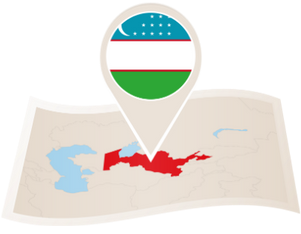
Modern day Uzbekistan
KNOWN FOR:
Being a highway robber A teacher of Imam Shafi'i
BRIEF BIO:
Grew up to be known as a notorious criminal engaged in highway robbery. He was feared amongst the people at the time and was well known in the area.
At the age of 40 years, whilst on his way to meet his beloved, he heard the verses of the Quran:
‘Has not the time come for the hearts of those who believe (in the Oneness of Allah) to be affected by Allah's Reminder (this Qur'an)...’ [Surah Hadid 16]
He replied “Nay indeed my Lord, the time has come”. He turned his life around and vowed to devote himself in worship to Allah and moved to Makkah. He became an Imam of the deen and was one of the teachers of Imam Shafi'i.
736-797 CE (118-181 AH) ABDULLAH IBN AL-MUBARAK Islamic world scholar
736-797 CE (118-181 AH) ABDULLAH IBN AL-MUBARAK Islamic world scholar
750 CE (132 AH) Establishment of the Abbasid Caliphate - The Abbasids came to power after a civil war ending Umayyad rule, establishing a new caliphate that would last until 1258 CE (656 AH) Islamic world
750 CE (132 AH) Establishment of the Abbasid Caliphate - The Abbasids came to power after a civil war ending Umayyad rule, establishing a new caliphate that would last until 1258 CE (656 AH) Islamic world
751 CE (133 AH) Abbasid Victory at Talas — Under the command of Ziyad ibn Salih, Abbasid forces defeated Tang Chinese forces at the Battle of Talas near the Talas River (modern-day Taraz, Kazakhstan), consolidating Muslim hold on Transoxiana (Central Asia) for the next 400 years. This battle also facilitated the transfer of Chinese papermaking technology to the Islamic world. Islamic world Explore the Spread of Islam +
762 CE (145 AH) Founding of Baghdad - Under Caliph Al-Mansur, Baghdad was founded and established as the capital of the Abbasid Caliphate in modern-day Iraq, becoming a major centre of Islamic culture and learning Islamic world
774 CE Lombard kingdom comes to an end after invasion by Frankish-Carolingian ruler Charlemagne politics and war
774 CE Lombard kingdom comes to an end after invasion by Frankish-Carolingian ruler Charlemagne politics and war
767-820 CE (150-204 AH) IMAM AL-SHAFIʿI Islamic world scholar
780-855 CE (164-241 AH) AHMAD IBN HANBAL Islamic world scholar
780-855 CE (164-241 AH) AHMAD IBN HANBAL Islamic world scholar
Imam Ahmad ibn Hanbal (780-855 CE / 164-241 AH)
NAMES
Abu Abdillah Ahmad Ibn Muhammad Ibn Hanbal Ibn Hilal Ibn Asad
LIVED: 9TH CENTURY
164-241H / 780-855 CE He was from those that came after the tabi’ee tabi’een
FROM: BAGHDAD
He was Ash-Shaybanee from the tribe of Shayban, who was Adnani.
KNOWN FOR:
His strength in defending the Sunnah on the day of the Mihnah (inquisition)
His vast knowledge in the science of hadeeth
Being one of the four imams of the madhahib
Imam of the Hanbali madhab
STUDENT OF:
He took knowledge from the imams of the Sunnah including:
Sufyan Ibn Uyaynah
Abdurrazzaq
Imam Ash-Shafi’ee
BOOKS
NOTABLE BOOKS:
He compiled the Musnad – one of the largest and earliest compilations of Hadeeth, with about 30,000 Hadeeths in it.
The Book of Zuhd – wherein he mentions the narrations related to piety and purification of the soul and self.
Fada’il as-Sahaba (Virtues of the Companions) – wherein he mentions the narrations related to the Companions of the Messenger and their virtues.
INTERESTING FACT
Imam Ahmad memorised 1 million hadeeths with their chains of narrations, at a time when the Arabs didn’t even have a word for million.
BRIEF BIO:
Imam Ahmad grew up under the care of his mother as an orphan, as his father had died close to the time of his birth. She taught him manners and etiquettes and was keen with regards to his studies. He began seeking knowledge at the age of 15 and took a keen interest in Hadeeth.
He was a pious man and was named an Imam in Zuhd by Imam ash-Shafi’ee.
He endured persecution and imprisonment during the Mihna (the Inquisition) under the Abbasid Caliph Al-Ma'mun, who sought to impose the Mutazilite doctrine that the Quran was created. Imam Ahmad refused to accept this doctrine which caused him to be imprisoned for most of his life.
And on the day of the Mihnah, he was the last man standing for the religion, with the standing of the Prophets as mentioned by the scholars of his time.
c. 780–850 CE (163–236 AH) Muhammad ibn Musa al-Khwarizmi: Algebra and Algorithms — Al-Khwarizmi formalized algebra, developed systematic methods for solving equations, and helped spread the Hindu-Arabic numeral system — the basis of modern math and computing. science islamic World Explore Islamic Scientists +
c. 780–850 CE (163–236 AH) Muhammad ibn Musa al-Khwarizmi: Algebra and Algorithms — Al-Khwarizmi formalized algebra, developed systematic methods for solving equations, and helped spread the Hindu-Arabic numeral system — the basis of modern math and computing. science islamic World Explore Islamic Scientists +
9TH CENTURY CE
800 CE The Frankish ruler Charlemagne is crowned emperor civilisation
c. 801–873 CE (185–259 AH) Al-Kindi: Optics and Knowledge — Al-Kindi advanced optics, cryptography, and helped bridge Greek and Islamic scientific knowledge. culture islamic World Explore Islamic Scientists +
c. 801–873 CE (185–259 AH) Al-Kindi: Optics and Knowledge — Al-Kindi advanced optics, cryptography, and helped bridge Greek and Islamic scientific knowledge. culture islamic World Explore Islamic Scientists +
800–1380 CE The Kanem-Bornu Empire thrives around Lake Chad, controlling trade routes linking North Africa to sub-Saharan Africa and adopting Islam as a state religion Civilisation
810-870 CE (194-256 AH) IMAM AL-BUKHARI Islamic world scholar
Imam Bukhari (810–870 CE / 194–256 AH)
NAMES
MUHAMMAD BIN ISMAIL BIN IBRAHIM IBN AL-MUGHIRAH AL-BUKHARI
ABU ABDULLAH (KUNYA)
LIVED: 9TH CENTURY
194 - 256 H / 810 - 870 CE
Either the 3rd generation (TABI'UN) or the 4th generation (TABI'UT TABI'IN) after the Prophet Muhammad ﷺ
FROM: BUKHARA, CENTRAL ASIA
PRESENT-DAY UZBEKISTAN
KNOWN FOR:
Renowned Imam and Scholar of Hadith (sayings and traditions of the Prophet Muhammad ﷺ)
Compiler of Sahih al-Bukhari — one of the most trusted collections of Hadith
STUDENT OF:
Studied under over a thousand scholars from the Imams of Ahlus Sunnah wal Jama'ah, including:
Makki bin Ibrahim (Balkh)
Sadaqa bin Fadl (Mar’a)
Yahya bin Yahya al-Muqri (Nisabur)
BOOKS
Sahih al-Bukhari
INTERESTING FACTS
Did you know Imam Bukhari was so meticulous in his research that he only narrated Hadith from scholars who were considered reliable authorities? Did you know He had such a powerful memory that he could recall both the Hadith **and the full chain of narrators**?
BRIEF BIO:
Imam Bukhari was known for his exceptional memory and lifelong dedication to seeking knowledge.
He began his journey at around 10 years old and spent more than 46 years traveling the Islamic world, collecting Hadith.
Over 16 years, he compiled Sahih al-Bukhari, selecting only the most authentic narrations from over 600,000 Hadiths he had gathered.
811-890 CE (195-277 AH) ABDURRAHMAN IBN ABI HATIM AL-RAZI Islamic world scholar
811-890 CE (195-277 AH) ABDURRAHMAN IBN ABI HATIM AL-RAZI Islamic world scholar
Abu Hatim al-Razi (811–890 CE / 195–277 AH)
NAMES
Abu Hatim Muhammad ibn Idrees al-Razi
LIVED: 9TH CENTURY
195–277 H / 811–890 CE
3rd generation — from the tabi‘ al-tabi‘een
FROM: RAYY
Modern-day Tehran, Iran
He belonged to the Handhalah clan within the larger Banu Tamim tribe — an influential tribe in Islamic history.
KNOWN FOR:
He was a prominent hadith scholar, known for his critical analysis of hadith narrators (jarh wa ta'dil)
and his contributions to Islamic jurisprudence and theology.
STUDENT OF:
Ahmad ibn Hanbal (key figure in hadith sciences and founder of the Hanbali school of thought)
Muhammad ibn Abdullah al-Ansari
Uthman ibn Heitham
Abu Dawood (compiler of Sunan Abu Dawood)
BOOKS
Al-Jarh wa al-Ta'dil (criticism and praise of narrators)
Kitab al-Ilal (book of causes in hadith transmission)
Aqeedat ar-Raziyeen (co-authored with Abu Zura al-Razi)
Kitab al-Tafsir (exegesis of the Qur’an)
Kitab al-Zuhd (book of asceticism)
Kitab al-Sunnan (book of sunan)
INTERESTING FACTS
Did you know he would have his son read hadith to him even in the bathroom — using every moment to seek knowledge? Did you know his son Abdur-Rahman continued his scholarly legacy and helped compile Aqeedat ar-Raziyeen?
BRIEF BIO:
Abu Hatim al-Razi was born in 195H in Rayy (modern-day Tehran). He began seeking knowledge
at the age of 20 and travelled across the Islamic world — including Sham, Iraq, Hijaz,
Palestine, and Syria — often on foot in search of hadith.
He is remembered for his commitment to hadith sciences, his extensive travels, and his
contribution to Islamic scholarship. His son, Abdur-Rahman, later became a respected
scholar and continued his legacy.
819–875 CE (204–261 AH) IMAM MUSLIM Islamic world scholar
819 CE (204 AH) Rise of the Samanid Dynasty - Former Abbasid governors in eastern Iran asserted independence, establishing the Samanid dynasty that would rule until 999 CE (389 AH) Islamic world
826–901 CE (210–288 AH) Thabit ibn Qurra: Mathematics and Astronomy — Expanded Greek mathematics, made major contributions to geometry and number theory, and influenced medieval astronomy. science Islamic World Explore Islamic Scientists +
826–901 CE (210–288 AH) Thabit ibn Qurra: Mathematics and Astronomy — Expanded Greek mathematics, made major contributions to geometry and number theory, and influenced medieval astronomy. science Islamic World Explore Islamic Scientists +
c. 850 CE Invention of gunpowder in China Invention
853-933 CE (239-321 AH) ABU JAFAR AL-TAHAWI Islamic world scholar
853-933 CE (239-321 AH) ABU JAFAR AL-TAHAWI Islamic world scholar
857-930 CE (242-318 AH) IBN AL-MUNDHIR Islamic world scholar
858–929 CE (244–317 AH) Al-Battani: Precision in Astronomy — Refined measurements of celestial movements and trigonometric functions, laying foundations for later astronomy and navigation. science islamic World Explore Islamic Scientists +
858–929 CE (244–317 AH) Al-Battani: Precision in Astronomy — Refined measurements of celestial movements and trigonometric functions, laying foundations for later astronomy and navigation. science islamic World Explore Islamic Scientists +
862 CE The people of Novgorod invite the Swedish Viking Rurik to rule them civilisation
862 CE The people of Novgorod invite the Swedish Viking Rurik to rule them civilisation
865–925 CE (251–312 AH) Al-Razi: Clinical Medicine and Chemistry — Distinguished diseases like smallpox and measles, promoted clinical observation, and wrote influential medical encyclopedias used for centuries. science islamic World Explore Islamic Scientists +
867-941 CE (253-329 AH) ABU AL-HASAN AL-BARBAHARI Islamic world scholar
867-941 CE (253-329 AH) ABU AL-HASAN AL-BARBAHARI Islamic world scholar
Abu Muhammad al-Barbahari (867–941 CE / 253–329 AH)
NAMES
Abu Muhammad al-Hasan bin Ali bin Khalaf al-Barbahari
LIVED: 9TH CENTURY
253–329 H / 867–941 CE
He was three years old at the death of Imam al-Bukhari, and came after that generation.
FROM: IRAQ
KNOWN FOR:
He was one of the greater scholars of the Hanaabilah and a caller to the Sunnah. He was very stern against the people of innovations and deviant sects, opposing them with his speech and his actions.
Ibn Battah and Imam Ahmad's son were among his students.
STUDENT OF:
Ahmad ibn Muhammad al-Hajjaj Abu Bakr al-Marroodhi (d. 275 H), famous student of Imam Ahmad
Sahl ibn Abdillah ibn Yunus at-Tustari Abu Muhammad (d. 283 H)
Al-Fath ibn Shukhruf (d. 273 H)
BOOKS
Sharh-us Sunnah
INTERESTING FACTS
Did you know? His name comes from “al-barbahar,” a type of medicine imported from India, suggesting he may have worked with or traded it. Did you know? When he passed away, only one person was seen praying over him. However, a lady reported seeing figures dressed in white and green garments filling the room, indicating a miraculous unseen presence.
BRIEF BIO:
He was born during the khilaafah of Mu'tazi billah Muhammad. He grew up in an unstable political environment, but during a time when knowledge was flourishing and Ahl al-Sunnah were widespread.
He was a contemporary of Imams such as Ibn Majah, Abu Dawud As-Sijistani, Hanbal ibn Ishaq (student of Imam Ahmad), and Ibn Qutaybah. Fully acquainted with the madhhab of Imam Ahmad, he delved deeply into knowledge, acquiring aqeedah, fiqh, and other sciences. He was influenced by Imam Ahmad’s students and was also a poet. Known for his piety and abstinence from worldly life, he stood firm for religion.
In Safar 323 H, his speeches gained influence, forbidding innovations. Innovators then persuaded Caliph Ar-Radhi to silence him. Al-Barbahari was forced into hiding and passed away in Rajab 329 AH at the age of 76 or 77.
869 CE Last dated inscription made at the Maya city-state of Tikal, which disappears shortly thereafter civilisation
892 CE (279 AH) Samanids Establish Bukhara as Capital - The Samanids took Bukhara (in modern-day Uzbekistan) and made it their capital, transforming it into a major centre of Persian culture and Islamic scholarship Islamic world
892 CE (279 AH) Samanids Establish Bukhara as Capital - The Samanids took Bukhara (in modern-day Uzbekistan) and made it their capital, transforming it into a major centre of Persian culture and Islamic scholarship Islamic world
893–970 CE (280–360 AH) IMAM AL-AJURI Islamic world scholar
Abu Bakr al-Ajurri (893–970 CE / 280–360 AH)
NAMES
Abu Bakr Muhammad ibn al-Husayn ibn Abdillah al-Baghdadi al-Ajurri
LIVED: 10TH CENTURY
280–360 H / 893–970 CE
He came after the period of the great imams, such as Imam Ahmad ibn Hanbal.
FROM: BAGHDAD, IRAQ
KNOWN FOR:
Ash-Shari'ah: considered an encyclopedia on Islamic creed and jurisprudence based on the methodology of the Qur'an and Sunnah.
STUDENT OF:
Abu Muslim Muhammad ibn Yahya al-Marwazi
Abu Shu'aib al-Harraami
Ahmad ibn Yahya al-Hulwaani
Al-Hasan ibn Ali al-Qattan
Ja'far ibn Muhammad al-Firyaaqi
Ibn Abi Dawud
BOOKS
Ash-Shari'ah fi Sunnah
Kitab ar-Ro'yah
Al-Ghurabah
Akhlaq al-'Ulama
INTERESTING FACT
When he visited Mecca, he greatly admired the place and supplicated to Allah saying, “O Allah, allow me to reside in this land for a year.” He eventually passed away in this very city.
BRIEF BIO:
He was a renowned Islamic scholar who travelled extensively in search of knowledge before eventually settling in Mecca, where he became well-known for his teachings in hadith, Islamic law (fiqh), and ethics. He was considered a precise narrator and was highly regarded for his piety, humility, and strict adherence to the Sunnah.
It is said that he followed both the Hanbali and Shafi'i madhabs but was not restricted to one school of thought in fiqh.
10TH CENTURY CE
909 CE (297 AH) Establishment of the Fatimid Caliphate - A Shia dynasty named after Fatimah عليها السلام was established in Ifriqiya (modern-day Tunisia), claiming the caliphate in 910 CE (298 AH) Islamic world
909 CE (297 AH) Establishment of the Fatimid Caliphate - A Shia dynasty named after Fatimah (peace be upon her) was established in Ifriqiya (modern-day Tunisia), claiming the caliphate in 910 CE (298 AH) Islamic world
934 CE (322 AH) Rise of the Buyid Dynasty - Daylamites from northern Iran expanded after Abbasid withdrawals, establishing the Buyid (Buwayhid) dynasty that would dominate the caliphate Islamic world
945 CE (334 AH) Buyids Take Control of Baghdad - Under the command of the Buyids, Baghdad (modern-day Iraq) was taken, allowing them to dominate the Abbasid caliphate whilst keeping the caliph as a figurehead Islamic world
945 CE (334 AH) Buyids Take Control of Baghdad - Under the command of the Buyids, Baghdad (modern-day Iraq) was taken, allowing them to dominate the Abbasid caliphate whilst keeping the caliph as a figurehead Islamic world
962–1027 CE (351–418 AH) AL-ALAKEE Islamic world scholar
965–1040 CE (354–431 AH) Ibn al-Haytham: Optics and Scientific Method — Proved that vision comes from light entering the eye, developed the camera obscura, and pioneered experimental science. invention islamic World Explore Islamic Scientists +
969 CE (358 AH) Fatimid Conquest of Egypt and Founding of Cairo - Under the Fatimid Caliphate, Egypt was conquered and Cairo (modern-day Cairo, Egypt) was founded as the new capital, establishing it as a major centre of Shia Islamic learning Islamic world
969 CE (358 AH) Fatimid Conquest of Egypt and Founding of Cairo - Under the Fatimid Caliphate, Egypt was conquered and Cairo (modern-day Cairo, Egypt) was founded as the new capital, establishing it as a major centre of Shia Islamic learning Islamic world
973–1050 CE (362–442 AH) Al-Biruni: Measuring the Earth — Calculated the Earth’s radius with great accuracy, studied geography, astronomy, calendars, and world cultures. science islamic World Explore Islamic Scientists +
977 CE (366 AH) Establishment of the Ghaznavid Dynasty - A Turkic dynasty based at Ghazni in Khurasan (modern-day Afghanistan) was established, eventually controlling much of the former western Samanid lands Islamic world
977 CE (366 AH) Establishment of the Ghaznavid Dynasty - A Turkic dynasty based at Ghazni in Khurasan (modern-day Afghanistan) was established, eventually controlling much of the former western Samanid lands Islamic world
978-1071 CE (368-463 AH) IBN ABD AL-BARR Islamic world scholar
d. 979 CE (369 AH) IBN ABI DAWOOD AS SIJISTANI Islamic world scholar
d. 979 CE (369 AH) IBN ABI DAWOOD AS SIJISTANI Islamic world scholar
980–1037 CE (370–428 AH) Ibn Sina: Canon of Medicine — Ibn Sina’s medical encyclopedia shaped medical education in the Islamic world and Europe for centuries. He systematized diagnosis, treatment, and pharmacology. science islamic World Explore Islamic Scientists +
980–1037 CE (370–428 AH) Ibn Sina: Canon of Medicine — Ibn Sina’s medical encyclopedia shaped medical education in the Islamic world and Europe for centuries. He systematized diagnosis, treatment, and pharmacology. science islamic World Explore Islamic Scientists +
999 CE (389 AH) Fall of the Samanid Dynasty - The Qarakhanids seized Bukhara (modern-day Uzbekistan), ending Samanid rule after nearly two centuries Islamic world
11TH CENTURY CE
1000 CE The city of Tiwanaku, centre of a major Andean civilisation, is abandoned Civilisation
1000 CE The city of Tiwanaku, centre of a major Andean civilisation, is abandoned Civilisation
1002-1071 CE (392-463 AH) AL-KHATIB AL-BAGHDADI Islamic world scholar
d. 1004 CE (395 AH) IBN MUNDA Islamic world scholar
d. 1004 CE (395 AH) IBN MUNDA Islamic world scholar
1005–1088 CE (396–481 AH) ABU ISMAIL AL-ANSARI Islamic world scholar
1005 CE (395 AH) Ghaznavid Expansion - Under Ghaznavid rule, much of the western Samanid territories were brought under control, extending their influence across Central Asia and into the Indian subcontinent Islamic world
1005 CE (395 AH) Ghaznavid Expansion - Under Ghaznavid rule, much of the western Samanid territories were brought under control, extending their influence across Central Asia and into the Indian subcontinent Islamic world
1037 CE (429 AH) Rise of the Seljuk Empire - Turkic rulers from Khurasan established the Seljuk Empire, beginning a period of Turkic dominance in the Islamic world Islamic world
1040 CE (431 AH) Seljuk Victory at Dandanqan - Under the command of the Seljuks, Ghaznavid forces were defeated at the Battle of Dandanqan (near modern-day Merv, Turkmenistan), reducing the Ghaznavids mainly to Ghazni and Lahore Islamic world
1040 CE (431 AH) Seljuk Victory at Dandanqan - Under the command of the Seljuks, Ghaznavid forces were defeated at the Battle of Dandanqan (near modern-day Merv, Turkmenistan), reducing the Ghaznavids mainly to Ghazni and Lahore Islamic world
1044-1122 CE (436-516 AH) AL-BAGHAWI Islamic world scholar
1048–1131 CE (440–525 AH) Omar Khayyam: Algebra and Astronomy — Advanced solutions for cubic equations and reformed the calendar with exceptional precision. science islamic World Explore Islamic Scientists +
1048–1131 CE (440–525 AH) Omar Khayyam: Algebra and Astronomy — Advanced solutions for cubic equations and reformed the calendar with exceptional precision. science islamic World Explore Islamic Scientists +
d. 1052 CE (444 AH) ABU NASR AS-SIJZI Islamic world scholar
1055 CE (447 AH) Seljuks Enter Baghdad - Under the command of the Seljuks, Baghdad (modern-day Iraq) was entered, ending Buyid control whilst recognising the Abbasid caliph, establishing Seljuk dominance over the caliphate Islamic world
1056 CE (448 AH) Rise of the Almoravid Dynasty - A confederation of Sanhaja Berbers established the Almoravid dynasty, which would control Morocco and parts of al-Andalus until 1147 CE (541 AH) Islamic world
1056 CE (448 AH) Rise of the Almoravid Dynasty - A confederation of Sanhaja Berbers established the Almoravid dynasty, which would control Morocco and parts of al-Andalus until 1147 CE (541 AH) Islamic world
1062 CE (454 AH) Founding of Marrakesh and Fall of Last Buyids - Under the Almoravids, Marrakesh (modern-day Marrakesh, Morocco) was founded as their capital. The last Buyid territories fell to the Seljuks, ending their dynasty Islamic world
1071 CE (463 AH) Seljuk Victory at Manzikert - Under Seljuk command, Byzantine forces were defeated at the Battle of Manzikert (near modern-day Malazgirt, eastern Turkey), opening Anatolia to Turkish settlement and Islamic expansion Islamic world
1071 CE (463 AH) Seljuk Victory at Manzikert - Under Seljuk command, Byzantine forces were defeated at the Battle of Manzikert (near modern-day Malazgirt, eastern Turkey), opening Anatolia to Turkish settlement and Islamic expansion Islamic world
1092 CE (485 AH) Death of Malik-Shah and Seljuk Fragmentation - Following the death of Sultan Malik-Shah, the Seljuk realm began to fracture into smaller competing states, weakening central authority Islamic world
1099 CE Armies of the First Crusade capture Jerusalem islamic world Explore The Crusades +
1099 CE Armies of the First Crusade capture Jerusalem islamic world Explore The Crusades +
12TH CENTURY CE
1100–1165 CE (494–560 AH) Al-Idrisi: Geography and Cartography — Created one of the most accurate medieval world maps, combining information from across Europe, Africa, and Asia. technology islamic World Explore Islamic Scientists +
1136–1206 CE (530–603 AH) Al-Jazari: Engineering and Automata — Designed advanced water clocks, pumps, and mechanical automata. His book of inventions influenced both Islamic and European engineering. invention islamic World Explore Islamic Scientists +
1136–1206 CE (530–603 AH) Al-Jazari: Engineering and Automata — Designed advanced water clocks, pumps, and mechanical automata. His book of inventions influenced both Islamic and European engineering. invention islamic World Explore Islamic Scientists +
d. 1140 CE (535 AH) ABUL QAASIM AT-TAYMI Islamic world scholar
1144-1194 CE (538-590 AH) ABU ISHAQ AL-SHATIBI Islamic world scholar
1144-1194 CE (538-590 AH) ABU ISHAQ AL-SHATIBI Islamic world scholar
1146-1203 CE (541-600 AH) ABDUL-GHANI AL-MAQDISI Islamic world scholar
1146–1223 CE (541–620 AH) IMAAM MUWAFFAQUD-DEEN ABDULLAAH IBN AHMAD IBN QUDAAMAH Islamic world scholar
1146–1223 CE (541–620 AH) IMAAM MUWAFFAQUD-DEEN ABDULLAAH IBN AHMAD IBN QUDAAMAH Islamic world scholar
1147 CE (541 AH) Fall of the Almoravid Dynasty - The Almohads, a rival Berber movement, captured Marrakesh (modern-day Marrakesh, Morocco), ending Almoravid rule Islamic world
1147 CE (541 AH) Fall of the Almoravid Dynasty - The Almohads, a rival Berber movement, captured Marrakesh (modern-day Marrakesh, Morocco), ending Almoravid rule Islamic world
d. 1166 CE (562 AH) ABU SA'AD AS-SAMAANI Islamic world scholar
1171 CE (567 AH) End of the Fatimid Caliphate - The Fatimid Caliphate ended in Egypt, replaced by Ayyubid rule under Salah ad-Din (Saladin) Islamic world
1180–1897 CE The Kingdom of Benin, in present-day Nigeria, becomes renowned for its sophisticated art, governance, and Benin Bronzes before being conquered by the British Civilisation
1180–1897 CE The Kingdom of Benin, in present-day Nigeria, becomes renowned for its sophisticated art, governance, and Benin Bronzes before being conquered by the British Civilisation
1181-1245 CE (577-643 AH) IBN AL-SALAH Islamic world scholar
1181-1245 CE (577-643 AH) IBN AL-SALAH Islamic world scholar
1186 CE (582 AH) Fall of the Ghaznavid Dynasty - The last Ghaznavid territories fell, ending nearly two centuries of Ghaznavid rule in Khurasan and northern India Islamic world
d. 1188 CE (584 AH) ABU BAKR MUHAMMAD BIN MUSA AL-HAZIMI Islamic world scholar
1194 CE (590 AH) End of the Seljuk Empire - The Great Seljuk Empire came to an end, though various Seljuk successor states continued in Anatolia and elsewhere Islamic world
1194 CE (590 AH) End of the Seljuk Empire - The Great Seljuk Empire came to an end, though various Seljuk successor states continued in Anatolia and elsewhere Islamic world
13TH CENTURY CE
1201–1274 CE (597–672 AH) Nasir al-Din al-Tusi: Astronomy and Mathematics — Developed the Tusi couple, a key astronomical model later used by Copernicus, and advanced trigonometry as a separate discipline. science islamic World Explore Islamic Scientists +
1201-1267 CE (598-665 AH) SHIHAB AL-DIN ABU SHAMA Islamic world scholar
1201-1267 CE (598-665 AH) SHIHAB AL-DIN ABU SHAMA Islamic world scholar
1204 CE Constantinople is captured by the Fourth Crusade; Crusader armies stormed and brutally sacked the Byzantine capital. The event caused massive destruction: libraries, churches, and relics were looted. politics and war Explore the Crusades +
1204 CE Constantinople is captured by the Fourth Crusade; Crusader armies stormed and brutally sacked the Byzantine capital. The event caused massive destruction: libraries, churches, and relics were looted. politics and war Explore the Crusades +
1206 CE The Delhi Sultanate is established in India islamic world
1220–1450 CE The Kingdom of Zimbabwe develops in southern Africa, famed for its stone-built capital Great Zimbabwe and its role in regional gold and ivory trade Civilisation
1220–1450 CE The Kingdom of Zimbabwe develops in southern Africa, famed for its stone-built capital Great Zimbabwe and its role in regional gold and ivory trade Civilisation
1228-1303 CE (625-702 AH) ABU FATH IBN DAQIQ AL-ID Islamic world scholar
1234-1277 CE (631-676 AH) IMAM NAWAWI Islamic world scholar
1234-1277 CE (631-676 AH) IMAM NAWAWI Islamic world scholar
Imam al-Nawawi (1233–1277 CE / 631–676 AH)
NAMES
Yahya ibn Sharaf ibn Hasan ibn Hussain ibn Jum’ah ibn Hizam al-Hazimi al-‘Alim Muhyiddin
Abu Zakariya al-Nawawi al-Dimashqi
LIVED: 13TH CENTURY
631–676 AH / 1233–1277 CE
FROM: NAWA, DAMASCUS
Nawa, a town in the region of Damascus (Sham).
His lineage is traced back to a family in Nawa, Damascus.
KNOWN FOR:
A great scholar of hadith, Islamic jurisprudence, and Arabic literature.
Best known for his works, including:
• Al-Arba’een al-Nawawiyah (The Forty Hadith)
• Riyadh as-Saliheen
BOOKS
• Al-Arba’een al-Nawawiyah (The Forty Hadith)
• Riyadh as-Saliheen
• Al-Majmoo’ (Shafi’i jurisprudence)
• Tahdhib al-Asma wa al-Lughat (linguistics and biographies)
• Minhaj at-Talibin (Shafi’i fiqh)
• Juz’ fīhi dhikru i’tiqād as-salaf fī al-huruf wa al-aswat – a treatise affirming the creed of the Salaf,
completed less than five months before his passing.
INTERESTING FACTS
Did you know? Imam al-Nawawi passed away at the young age of 45, yet his scholarly contributions remain invaluable to Islamic literature.
Did you know? He was known for his ascetic lifestyle, refraining from marriage and worldly pleasures
to focus solely on his studies and worship.
Did you know? Despite his short life, Imam al-Nawawi authored many works, demonstrating his dedication
and the blessing he received from Allah.
BRIEF BIO:
Birth and early life: He was born in Nawa in 631 AH (1233 CE).
Education: He studied in Damascus and became known for his dedication to learning, his scholarly
contributions, and his deep understanding of the Shafi’i madhhab.
Creed: An-Nawawi adhered to the creed of the Salaf, affirming the attributes of Allah as stated in
the Qur'an and Sunnah without delving into speculative theology. In his treatise, he explicitly opposed
the Ash‘ari school’s theological rhetoric, stating that he believed in all prophetic traditions regarding
Allah's attributes without adding, omitting, or interpreting their details.
Contributions: He authored numerous works despite his relatively short life, including his famous
Arba'een al-Nawawiyah, a collection of forty essential hadith.
Death: He passed away in 676 AH (1277 CE) at the age of 45.
1235–1660 CE The Mali Empire rises in West Africa, reaching its peak under Mansa Musa, whose wealth and pilgrimage to Mecca made Timbuktu a centre of trade and learning Civilisation Explore the life of Mansa Musa +
d. 1245 CE (643 AH) DIYAA AL-MAQDASI Islamic world scholar
d. 1245 CE (643 AH) DIYAA AL-MAQDASI Islamic world scholar
1258 CE Mongol armies sack Baghdad islamic world
1258 CE Mongol armies sack Baghdad islamic world
1263-1328 CE (661-728 AH) IBN TAYMIYYAH Islamic world scholar
Ibn Taymiyyah (1263–1328 CE / 661–728 AH)
NAMES
Abul-Abbas Ahmed ibn Abd al-Halim ibn Abd as-Salaam ibn Taymiyyah
He was born on a Monday in the city of Harran, which was in Syria at the time
(modern-day Turkey).
Lineage: al-Harrani
KNOWN FOR:
His vast knowledge in all the Islamic sciences, ranging from fiqh and hadith to grammar and tafseer.
His numerous works, numbering over 300 volumes (some lost today).
His in-depth refutations of many deviated sects and religions.
TEACHERS:
His father and grandfather, who were scholars of the Hanbali madhab.
The nephew of Imam Ibn Qudaamah.
Adh-Dhahabi relayed that Ibn Taymiyyah listed 43 teachers, including 3 female scholars.
He had a vast library and loved reading and memorising from a young age.
BOOKS
• Al-Aqeedah al-Wasitiyyah (the Wasitee creed) – written between ‘asr and maghrib
• Al-Jawab as-Sahih (the correct reply) – refuting Christian doubts
• Many small treatises and fatawas collected in 20 volumes
INTERESTING FACTS
He was born into a household of scholars; both his father and grandfather were respected scholars.
He fought in battles against the Tartars and was successful on the battleground.
BRIEF BIO:
Early in his life, he fled Harran with his father and brothers due to an oppressive Tartar occupation
in 667 AH. They migrated to Damascus, where he later died.
He memorised the Qur'an by age 7, took deep interest in knowledge early, and began issuing fatwas
and delivering lessons at only 17.
He was imprisoned multiple times due to controversies regarding his verdicts on divorce and marriage,
his rejection of Sufi innovations, and slander that he held anthropomorphic beliefs.
Among his most prominent students were:
Imam Ibn Qayyim al-Jawziyyah, al-Hafidh Ibn Kathir, al-Hafidh adh-Dhahabi, and others.
1270 CE Mongols establish a government in Korea; the Goryeo court survives only on an offshore island politics and war Explore the Mongol Conquests +
1270 CE Mongols establish a government in Korea; the Goryeo court survives only on an offshore island politics and war Explore the Mongol Conquests +
1274-1348 CE (673-748 AH) AL-DHAHABI Islamic world scholar
Adh-Dhahabi (1274–1348 CE / 673–748 AH)
NAMES
Shams Ad-Din Muhammad Ibn Ahmad Ibn ‘Uthman Adh-Dhahabi
LIVED: 14TH CENTURY
673–748 AH / 1274–1348 CE
FROM: DAMASCUS, SYRIA
KNOWN FOR:
A scholar of hadith and islamic history, renowned for his expertise in hadith,
biographical criticism, and historical documentation.
He is widely cited for his meticulous work in recording the lives and contributions
of early islamic scholars.
TEACHERS:
Ibn Taymiyyah
BOOKS
• Siyar A‘lam An-nubala — biographies of notable figures and one of the most essential works in islamic scholarship.
• Tadhkirat Al-Huffadh — memorial of hadith masters with detailed accounts of their lives and narrations.
BRIEF BIO:
Adh-Dhahabi was a distinguished scholar from Damascus known for his precision in documenting the lives of scholars and his rigorous authentication of hadith.
His biographical works remain among the most relied upon sources for understanding early Islamic scholarship.
1279 CE Mongols complete conquest of Southern Song; Yuan dynasty established civilisation Explore the Mongol Conquests +
1280s CE (680s AH) Ottoman Empire: Rise of Osman - After the collapse of the Seljuk Empire, western Anatolia (modern-day Turkey) was divided into competing states known as Beyliks. One Beylik, based around the small town of Sogut (modern-day northwestern Turkey), began to expand under the leadership of Osman, the founder of the Ottoman dynasty, laying the foundations for what would become the Ottoman Empire Islamic world
1280s CE (680s AH) Ottoman Empire: Rise of Osman - After the collapse of the Seljuk Empire, western Anatolia (modern-day Turkey) was divided into competing states known as Beyliks. One Beylik, based around the small town of Sogut (modern-day northwestern Turkey), began to expand under the leadership of Osman, the founder of the Ottoman dynasty, laying the foundations for what would become the Ottoman Empire Islamic world
c. 1280 CE First true mechanical clocks appear in Europe Invention
1292-1350 CE (691-751 AH) IBN AL-QAYYIM Islamic world scholar
Ibn Al-Qayyim (1292–1350 CE / 691–751 AH)
NAMES
Shams Al-Din Abu ‘Abdullah Muhammad Ibn Abi Bakr Ibn Ayyub Al-Zur‘i Al-Dimashqi
LIVED: 14TH CENTURY
691–751 AH / 1292–1350 CE
FROM: DAMASCUS, SYRIA
His lineage traces back to a family known for scholarship; his father was the custodian of the Al-Jawziyyah School.
KNOWN FOR:
Islamic jurisprudence (Fiqh)
Theology
Hadith studies
Sufism critique
Prolific writings in Islamic sciences
STUDENT OF:
Ibn Taymiyyah (his most notable teacher)
BOOKS
• Zad Al-Ma‘ad
• Madarij Al-Salikin
• I‘lam Al-Muwaqqi‘in
INTERESTING FACTS
He was imprisoned alongside Ibn Taymiyyah for holding and spreading views that challenged certain established norms of his time.
Ibn Al-Qayyim was given his name because his father was the custodian (Al-Qayyim) of the Al-Jawziyyah School in Damascus.
BRIEF BIO:
Ibn Al-Qayyim was a distinguished scholar in various Islamic sciences and is well known for his close companionship with his teacher Ibn Taymiyyah. His studies included jurisprudence, theology, and Hadith, leading to extensive works across Islamic disciplines.
His writings continue to be influential in Islamic thought.
14TH CENTURY CE
1301-1373 CE (701-774 AH) IBN KATHIR Islamic world scholar
1301-1373 CE (701-774 AH) IBN KATHIR Islamic world scholar
Ibn Kathir (1300–1373 CE / 701–774 AH)
NAMES
Abul-Fidaa' Isma'eel Ibn Umar Ibn Katheer Ibn Daw' Ibn Katheer
LIVED: 14TH CENTURY
701–774 AH / 1300–1373 CE
FROM: DAMASCUS, SYRIA
He was born in Mijdal, a village to the east of Basra, in the province of Damascus, where his father was a khateeb.
Lineage: Al-Qurashee, Al-Basrawee (an ascription to Basra), then Ad-Dimashqee (an ascription to Damascus)
KNOWN FOR:
His book on tafseer, which is one of the most well-known explanations of the Qur'an. Some scholars said the ummah has not seen a tafseer like his before or after.
TEACHERS:
His most well-known teachers:
• Shaykh Al-Islam Ibn Taymiyyah, from whose closest students he was
• Al-Mizzee, the Imam and Muhaddith; he closely accompanied him and married his daughter
• Adh-Dhahabi, the Imam and historian of Islam, who was also a student of Ibn Taymiyyah
BOOKS
• Tafseer Ibn Katheer — his most famous work and one of the greatest works of tafseer ever written
• Al-Bidayah Wan-Nihayah — a large work of Islamic history from Adam to his time
• Al-Fusool Fi Seeratil-Rasool — a summarised work on the life of the Messenger
INTERESTING FACT
He endured suffering from those in power due to following some of the opinions of his teacher, Ibn Taymiyyah.
BRIEF BIO:
His father died when he was six, after which he moved with his brother to Damascus. He memorised the Qur'an shortly after, at the age of ten, and learned the different recitations, excelling in tafseer.
He married Zaynab, the daughter of Imam Al-Mizzee, through whom he became closely connected and studied deeply. He excelled in fiqh, Arabic grammar, tafseer and hadeeth, studying narrations and their defects closely.
He became the Shaykh of the Salihiyyah School after the death of his teacher Adh-Dhahabi, and briefly the Shaykh of Darul-Hadeeth Al-Ashrafiyyah after As-Subkee. He also taught in several schools in Damascus.
He died on Thursday, 26th Sha’baan 774 AH in Damascus where he was buried.
1304–1375 CE (704–777 AH) IBN AL-SHATIR: PLANETARY MODELS — Created precise planetary models centuries before Copernicus. science Islamic World Explore Islamic Scientists +
d. 1305 CE (705 AH) IBN KHALAF AL-DIMYATI Islamic world scholar
d. 1305 CE (705 AH) IBN KHALAF AL-DIMYATI Islamic world scholar
1326 CE (726 AH) Ottoman Empire: Conquest of Bursa - Under the command of Orhan, son of Osman and second Ottoman ruler, the important Byzantine town of Bursa (modern-day northwestern Turkey) was captured and established as the first Ottoman capital. From there, Orhan conquered much of the rest of Anatolia and sent the first Ottoman forces into Europe Islamic world
1326 CE (726 AH) Ottoman Empire: Conquest of Bursa - Under the command of Orhan, son of Osman and second Ottoman ruler, the important Byzantine town of Bursa (modern-day northwestern Turkey) was captured and established as the first Ottoman capital. From there, Orhan conquered much of the rest of Anatolia and sent the first Ottoman forces into Europe Islamic world
1326–1402 CE (726–805 AH) Ottoman Expansion in Anatolia — Under Orhan’s rule, the Ottomans conquered most remaining Byzantine cities in northwest Anatolia. Anatolia was later unified under Bayezid I, grandson of Orhan, who subdued the Beyliks in the southwest after becoming sultan in 1389 CE (791 AH). Islamic world
1332–1406 CE (732–808 AH) Ibn Khaldun: Sociology and History — Developed theories on the rise and fall of civilizations and early concepts of economics and social science. culture islamic World Explore Islamic Scientists +
1335-1393 CE (736-795 AH) IBN RAJAB AL-HANBALI Islamic world scholar
1337 CE The Hundred Years War between England and France begins politics and war Explore The 100 Years war +
1337 CE The Hundred Years War between England and France begins politics and war Explore The 100 Years war +
1354 CE (755 AH) Ottoman Empire: Entry into Europe — The Ottomans crossed into Gallipoli (modern-day northwestern Turkey, on the European side of the Dardanelles), establishing their first foothold in Europe and beginning their expansion into the Balkans. Islamic world
1354 CE (755 AH) Ottoman Empire: Entry into Europe — The Ottomans crossed into Gallipoli (modern-day northwestern Turkey, on the European side of the Dardanelles), establishing their first foothold in Europe and beginning their expansion into the Balkans. Islamic world
b.1363 CE (764 AH) IBN ABDUL HADI Islamic world scholar
b.1363 CE (764 AH) IBN ABDUL HADI Islamic world scholar
1372–1449 CE (773–852 AH) IBN HAJAR AL-ASQALANI Islamic world scholar
Ibn Hajar Al-Asqalani (1372–1449 CE / 773–852 AH)
NAMES
Abu Fadl Jihabuddin Ahmed Ibn Ali Ibn Muhammad Ibn Ahmed Al-Kinani Al-Shafi'i, commonly known as Ibn Hajar Al-Asqalani.
LIVED: 15TH CENTURY
773–852 AH / 1372–1449 CE
FROM: EGYPT
Born in Egypt; his lineage traces back to Asqalan in Palestine.
Lineage: attributed to the tribe of Kinani. His nisbah “Al-Asqalani” indicates his ancestral origin from Asqalan.
KNOWN FOR:
Renowned hadith scholar, memoriser, and historian.
Best known for his commentary on Sahih Al-Bukhari, Fath Al-Bari.
Recognised for his vast contributions to hadith sciences and jurisprudence.
STUDENT OF:
Studied under many eminent scholars, including:
Zayn Al-Iraqi
Al-Balghini
Ibn Mulaqin
Al-Izz Ibn Al-Jamaa
Ibn Hisham (Arabic language expert)
Al-Majd Al-Sayruzabadi
BOOKS
Authored over 150 books, most notably:
• Fath Al-Bari — commentary on Sahih Al-Bukhari
• Al-Isaba Fi Tamyiz Al-Sahaba — a work on the lives of the companions
• Various works in hadith (narrator sciences) and jurisprudence
INTERESTING FACTS
Known for his phenomenal memory; he once read Sahih Muslim in two days.
Initially reluctant to become a judge but later accepted upon insistence from the Sultan and other scholars.
Authored more than 250 works, demonstrating vast knowledge in hadith and rijal (narrator sciences).
Known for his light humour and friendly manner with scholars and students.
BRIEF BIO:
Born in 773 AH in Egypt. He became an orphan early in life, losing both parents. He began memorising the Qur'an at the age of five and completed it by nine.
He was deeply drawn to hadith sciences from a young age, studying under many sheikhs in Hijaz, Al-Sham, and Egypt. His exceptional memory allowed him to memorise texts quickly.
He taught tafsir, hadith, and fiqh at major institutions such as Al-Azhar and Jami' Amr in Cairo. He travelled to more than fifty cities, including Hijaz, Damascus, Yemen, and Palestine, seeking knowledge. He was known for teaching, giving fatwas, and preaching widely.
His works had a lasting influence, especially in hadith sciences. His students included notable scholars such as Imam Al-Sakhawi. His masterpiece Fath Al-Bari remains widely studied today.
He served as a judge (Qadi) in Egypt and later in Sham, holding the position of chief judge multiple times until his passing in 852 AH.
1389 CE (791 AH) Ottoman Empire: Victory at Kosovo — Under the command of Sultan Murad I, the third Ottoman ruler, Ottoman forces defeated Serbia at the Battle of Kosovo (modern-day Kosovo), marking the beginning of Ottoman supremacy in the Balkans. The Ottomans had occupied much of Thrace (modern-day southeastern Balkans), making Edirne (Adrianople) the new capital. Islamic world
1394–1449 CE (797–853 AH) Ulugh Beg: Observatories and Star Catalogues — Built a major observatory in Samarkand and produced one of the most accurate star catalogs of his time. science islamic World Explore Islamic Scientists +
1394–1449 CE (797–853 AH) Ulugh Beg: Observatories and Star Catalogues — Built a major observatory in Samarkand and produced one of the most accurate star catalogs of his time. science islamic World Explore Islamic Scientists +
15TH CENTURY CE
1400–1402 CE (803–805 AH) Ottoman Empire: Mongol Threat Under Timur — The Mongol-Turkic conqueror Timur (Tamerlane), angered by Sultan Bayezid I’s demands for tribute from one of his vassals, invaded Ottoman territory. At the Battle of Ankara (1402 / 805 AH) (modern-day Ankara, Turkey), Timur defeated Sultan Bayezid I, causing many Anatolian Beyliks to break away from Ottoman rule. Islamic world
1400–1402 CE (803–805 AH) Ottoman Empire: Mongol Threat Under Timur — The Mongol-Turkic conqueror Timur (Tamerlane), angered by Sultan Bayezid I’s demands for tribute from one of his vassals, invaded Ottoman territory. At the Battle of Ankara (1402 / 805 AH) (modern-day Ankara, Turkey), Timur defeated Sultan Bayezid I, causing many Anatolian Beyliks to break away from Ottoman rule. Islamic world
d. 1404 CE (807 AH) NUAYD AL-HAYTHAMI Islamic world scholar
d. 1404 CE (807 AH) NUR UDDIN AL-HAYTHAMI Islamic world scholar
1405 CE (808 AH) Ottoman Empire: Death of Timur — The death of Timur, the Mongol-Turkic conqueror, saved the Ottomans from further losses and allowed them to begin recovering their territories. Islamic world
1427–1497 CE (831–902 AH) AL-SAKHAWI Islamic world scholar
1427–1497 CE (831–902 AH) AL-SAKHAWI Islamic world scholar
1429 CE The Aztecs establish the Triple Alliance with other states in the Valley of Mexico, which forms the basis of their empire civilisation
1429 CE The Aztecs establish the Triple Alliance with other states in the Valley of Mexico, which forms the basis of their empire civilisation
1430 CE (834 AH) Ottoman Empire: Conquest of Thessaloniki — Thessaloniki, also known as Salonika (modern-day Thessaloniki, northern Greece), was captured by Ottoman forces, further extending their control in the Balkans. Islamic world
d. 1437 CE (841 AH) BURHAN AL-HALABI Islamic world scholar
1438 CE Pachacuti begins a series of conquests that establishes the Inca Empire civilisation
1438 CE Pachacuti begins a series of conquests that establishes the Inca Empire civilisation
1441 CE The assassination of shogun Ashikaga Yoshinori sparks the Onin Wars and 150 years of Japanese disunity politics and war
1444 CE (848 AH) Ottoman Empire: Victory at Varna — An attempted crusade led by European Christian forces to prevent Ottoman expansion was defeated at the Battle of Varna (modern-day Varna, Bulgaria), securing Ottoman dominance in the region. Islamic world
1444 CE (848 AH) Ottoman Empire: Victory at Varna — An attempted crusade led by European Christian forces to prevent Ottoman expansion was defeated at the Battle of Varna (modern-day Varna, Bulgaria), securing Ottoman dominance in the region. Islamic world
1445–1505 CE (849–911 AH) IMAM AS-SUYOOTI Islamic world scholar
1451 CE (855 AH) Ottoman Empire: Mehmed II Becomes Sultan — By the time Mehmed II, also known as Mehmed the Conqueror, became the seventh Ottoman sultan, the Byzantine Empire consisted of little more than the city of Constantinople itself. Islamic world
1453 CE (857 AH) Ottoman Empire: Conquest of Constantinople — Under the command of Sultan Mehmed II, also known as Mehmed the Conqueror, Ottoman forces laid siege to Constantinople (modern-day Istanbul, Turkey) in April, cutting off the city's supply lines. The Byzantine Emperor Constantine XI Palaiologos resisted for nearly eight weeks before the Ottomans captured the city. The Byzantine Empire came to an end, and Constantinople became the new Ottoman capital. Islamic world
1453 CE (857 AH) Ottoman Empire: Conquest of Constantinople — Under the command of Sultan Mehmed II, also known as Mehmed the Conqueror, Ottoman forces laid siege to Constantinople (modern-day Istanbul, Turkey) in April, cutting off the city's supply lines. The Byzantine Emperor Constantine XI Palaiologos resisted for nearly eight weeks before the Ottomans captured the city. The Byzantine Empire came to an end, and Constantinople became the new Ottoman capital. Islamic world
1453 CE The Hundred Years War ends with France's recapture of Bordeaux from the English politics and war
1454 CE Gutenberg prints the first major book (Gutenberg Bible) using movable type Invention
1454 CE Gutenberg prints the first major book (Gutenberg Bible) using movable type Invention
1456 CE (860 AH) Ottoman Empire: Failed Siege of Belgrade — The failure of a siege by Sultan Mehmed II at Belgrade (modern-day Belgrade, Serbia) put a temporary halt to Ottoman advances into Hungary. Islamic world
1460 CE (865 AH) Ottoman Empire: Conquest of Morea — Having captured Constantinople, Sultan Mehmed II dealt with the remaining fragments of the Byzantine Empire, capturing the Morea, also known as the Peloponnese (modern-day southern Greece), and consolidating Ottoman control in Greece. Islamic world
1460 CE (865 AH) Ottoman Empire: Conquest of Morea — Having captured Constantinople, Sultan Mehmed II dealt with the remaining fragments of the Byzantine Empire, capturing the Morea, also known as the Peloponnese (modern-day southern Greece), and consolidating Ottoman control in Greece. Islamic world
1461 CE (866 AH) Ottoman Empire: Conquest of Trebizond — Ottoman forces under Sultan Mehmed II conquered the Empire of Trebizond (modern-day Trabzon, northeastern Turkey), a breakaway Byzantine region on the Black Sea coast, eliminating the last independent Greek state. Islamic world
1463 CE (868 AH) Ottoman Empire: Conquest of Bosnia — The defeat of the Kingdom of Bosnia by Ottoman forces under Sultan Mehmed II extended Ottoman control further into the Balkans, with resistance now confined to scattered fortresses and Venetian possessions along the Adriatic coast. Islamic world
1463 CE (868 AH) Ottoman Empire: Conquest of Bosnia — The defeat of the Kingdom of Bosnia by Ottoman forces under Sultan Mehmed II extended Ottoman control further into the Balkans, with resistance now confined to scattered fortresses and Venetian possessions along the Adriatic coast. Islamic world
1460–1481 CE (865–886 AH) Ottoman Empire: Consolidation Under Mehmed II — By the end of Sultan Mehmed II’s reign, the principalities of Wallachia (modern-day southern Romania) and Moldavia (modern-day northeastern Romania and Republic of Moldova) had been reduced to vassal status, and Ottoman rule in the Balkans was firmly established, with resistance confined to a few scattered fortresses and Venetian possessions in Greece along the Adriatic coast. Islamic world
1480 CE Ivan III of Russia establishes the independence of Muscovy from the Mongols politics and war
1480 CE Ivan III of Russia establishes the independence of Muscovy from the Mongols politics and war
d. 1503 CE (909 AH) YUSUF BIN HASAN AL-HANBALI Islamic world scholar
1581 CE Netherlands: Declared independence from Spain (Act of Abjuration). Historically part of the Habsburg Netherlands; medieval Dutch counties and cities existed long before. Nation Formation
1581 CE Netherlands: Declared independence from Spain (Act of Abjuration). Historically part of the Habsburg Netherlands; medieval Dutch counties and cities existed long before. politics and war
1526–1585 CE (932–993 AH) Taqi al-Din: Engineering and Astronomy — Built one of the most advanced observatories of the age in Istanbul and developed precise clocks and instruments. invention islamic World Explore Islamic Scientists +
1526 CE Babur invades north India and establishes the Mughal Empire Islamic World Explore Mughal India +
1526 CE Babur invades north India and establishes the Mughal Empire Islamic World Explore Mughal India +
1547–1621 CE (954–1030 AH) Baha al-Din al-Amili: Mathematics and Astronomy — A prominent mathematician and astronomer who helped spread scientific knowledge across Persia and the Ottoman world. science islamic World Explore Islamic Scientists +
1547–1621 CE (954–1030 AH) Baha al-Din al-Amili: Mathematics and Astronomy — A prominent mathematician and astronomer who helped spread scientific knowledge across Persia and the Ottoman world. science islamic World Explore Islamic Scientists +
17TH CENTURY CE
1600 CE Tokugawa Ieyasu wins the Battle of Sekigahara to complete the reunification of Japan politics and war
1607 CE The Dutch East India Company sets up a base on Ternate in the Moluccas trade
1609 CE Galileo makes pioneering telescope observations Science
1612 CE The English East India Company establishes a base at Surat, India trade
1612 CE The English East India Company establishes a base at Surat, India trade
1628 CE Shah Jahan is crowned emperor - the golden age of Mughal India begins islamic world Explore Mughal India +
1628 CE William Harvey publishes on the circulation of the blood Science
1628 CE William Harvey publishes on the circulation of the blood Science
d.1634 CE (1044 AH) IBN AL-TAHIR Islamic world scholar
1638 CE Portuguese and all other Europeans except the Dutch are expelled from Japan trade
1638 CE Portuguese and all other Europeans except the Dutch are expelled from Japan trade
1644 CE The Qing, incomers from Manchuria, overthrow the Ming to establish a new ruling dynasty in China politics and war Explore the Qing Dynasty +
1656 CE Dutch mathematician and physicist Christiaan Huygens constructs the first pendulum clock invention
1656 CE Dutch mathematician and physicist Christiaan Huygens constructs the first pendulum clock invention
1665 CE Robert Hooke publishes Micrographia, advancing early microscopy Science
1666 CE (1077 AH) AL-BAABILI Islamic world scholar
1674 CE Antonie van Leeuwenhoek observes microorganisms in letters to the Royal Society Science
1674 CE Antonie van Leeuwenhoek observes microorganisms in letters to the Royal Society Science
1688-1768 CE (1099-1182 AH) IMAM AS-SAN'ANI Islamic world scholar
1688-1768 CE (1099-1182 AH) IMAM AS-SAN'ANI Islamic world scholar
1687 CE English mathematician Isaac Newton publishes the Principia, setting out laws of motion and gravity science
1690 CE The English East India Company acquires Fort William trade
1690 CE The English East India Company acquires Fort William trade
1692 CE The Edict of Toleration of Christianity is passed in China religion
1694 CE Bank of England is established, modeling future central banks Economy
1694 CE Bank of England is established, modeling future central banks Economy
18TH CENTURY CE
1700 CE India, China, and Japan contribute roughly 50 percent of global GDP economy
1700 CE India, China, and Japan contribute roughly 50 percent of global GDP economy
1701-14 CE The War of Spanish Succession confirms the separation of the French and Spanish crowns and British control of Nova Scotia and Newfoundland politics and war
1703-1791 CE (1115-1206 AH) MUHAMMAD IBN ABD AL-WAHHAB Islamic world scholar
1707 CE United Kingdom: Created through the Acts of Union, formally uniting the Kingdom of England and the Kingdom of Scotland into a single sovereign state. The Kingdom of England was established in 927 CE and the Kingdom of Scotland in 843 CE. Nation Formation
1707 CE United Kingdom: Created through the Acts of Union, formally uniting the Kingdom of England and the Kingdom of Scotland into a single sovereign state. The Kingdom of England was established in 927 CE and the Kingdom of Scotland in 843 CE. Nation Formation
1712 CE Thomas Newcomen builds the first practical atmospheric steam engine Invention
1721 CE (1134 AH) ABDULLAH IBN SALIM AL-BASRI Islamic world scholar
d.1721 CE (1134 AH) ABDULLAH IBN SALIM AL-BASRI Islamic world scholar
1735 CE British clockmaker John Harrison completes his first marine chronometer, greatly improving the accuracy of navigation invenition
1735 CE British clockmaker John Harrison completes his first marine chronometer, greatly improving the accuracy of navigation invention
1750 CE Global population ≈ 715 million, concentrated in South & East Asia Population
1751 CE Denis Diderot publishes the first volume of his Encyclopédie culture
1751 CE Denis Diderot publishes the first volume of his Encyclopédie culture
1760-1834 CE (1173-1250 AH) ASH-SHAWKANI Islamic world scholar
1769 CE James Watt patents the separate-condenser steam engine improvement Invention
1769 CE James Watt patents the separate-condenser steam engine improvement Invention
1771 CE In Britain, Richard Arkwright opens the first modern factory using spinning machines powered by water Technology
d.1774 CE (1188 AH) AS-SAFAAREENI Islamic world scholar
d.1774 CE (1188 AH) AS-SAFAAREENI Islamic world scholar
1776 CE Continental Congress opens U.S. ports to foreign trade Trade
1776 CE Continental Congress opens U.S. ports to foreign trade Trade
1820 CE Global GDP reaches c.$ 700 billion (as calculated in 1990 terms) economy
1822 CE Brazil declares independence from Portugal, and Ecuador gains independence from Spain politics and war
1822 CE Brazil declares independence from Portugal, and Ecuador gains independence from Spain politics and war
1826 CE Joseph Nicéphore Niépce produces the first permanent photograph Invention
1830 CE Belgium: Gained independence from the Netherlands following the Belgian Revolution. Previously part of the Southern Netherlands under Spanish, Austrian, and French rule before incorporation into the United Kingdom of the Netherlands in 1815. Nation Formation
1830 CE Belgium: Gained independence from the Netherlands following the Belgian Revolution. Previously part of the Southern Netherlands under Spanish, Austrian, and French rule before incorporation into the United Kingdom of the Netherlands in 1815. Nation Formation
1830 CE Greece: Recognised as independent from the Ottoman Empire following the Greek War of Independence. Ancient Greek city-states flourished from the 8th century BCE; the region later became part of the Byzantine Empire and subsequently fell under Ottoman rule from the 15th century.
Nation Formation
1830 CE The genocide of Tasmanian Aboriginal people leads to the near-extinction of the community Population
1830 CE The genocide of Tasmanian Aboriginal people leads to the near-extinction of the community Population
1830 CE George Stephenson's Rocket engine pulls the first passengers along England's Liverpool and Manchester Railway Technology
1837 CE Charles Babbage designs the Analytical Engine, an early concept of a programmable computer Technology
1837 CE Charles Babbage designs the Analytical Engine, an early concept of a programmable computer Technology
1839 CE Luxembourg: Full independence recognised in the Treaty of London, establishing it as a sovereign grand duchy. The County of Luxembourg was founded in 963 CE and became a significant medieval territory within the Holy Roman Empire. Nation Formation
1839 CE Luxembourg: Full independence recognised in the Treaty of London, establishing it as a sovereign grand duchy. The County of Luxembourg was founded in 963 CE and became a significant medieval territory within the Holy Roman Empire. politics and war
1844 CE Samuel Morse sends the first telegraph message (Washington, DC to Baltimore) Technology
1844 CE Samuel Morse sends the first telegraph message (Washington, DC to Baltimore) Technology
1848 CE London becomes the world’s largest city; population surges toward 2.7 million Population
1849–1852 CE Britain annexes Punjab (1849) and Lower Burma (1852); Upper Burma is annexed in 1885 Politics and war
1849–1852 CE Britain annexes Punjab (1849) and Lower Burma (1852); Upper Burma is annexed in 1885 Politics and war
1859–1867 CE France expands in Southeast Asia: Saigon captured, Cambodia protectorate, Cochinchina consolidated Politics and war
1859 CE Romania: Formed through the union of the principalities of Wallachia and Moldavia under a single ruler, marking the foundation of the modern Romanian state. Independence from the Ottoman Empire was internationally recognized in 1878. The region originated as medieval principalities in the 14th century.
Nation Formation
1859 CE Romania: Formed through the union of the principalities of Wallachia and Moldavia under a single ruler, marking the foundation of the modern Romanian state. Independence from the Ottoman Empire was internationally recognized in 1878. The region originated as medieval principalities in the 14th century.
Nation Formation
1861 CE Italy: Proclaimed as the Kingdom of Italy during the Risorgimento, uniting regional states under one monarchy. Preceded by numerous Italian states and the Roman Empire.
Nation Formation
1861 CE Italy: Proclaimed as the Kingdom of Italy during the Risorgimento, uniting regional states under one monarchy. Preceded by numerous Italian states and the Roman Empire.
Nation Formation
1861 CE James Maxwell formulates equations of electromagnetism Science
1864–1870 CE Paraguayan War: Argentina, Brazil, and Uruguay defeat Paraguay (War of the Triple Alliance) Politics and war
1864–1870 CE Paraguayan War: Argentina, Brazil, and Uruguay defeat Paraguay (War of the Triple Alliance) Politics and war
1869 CE U.S. Transcontinental Railroad completed (Golden Spike, Promontory Summit) Technology
1869 CE U.S. Transcontinental Railroad completed (Golden Spike, Promontory Summit) Technology
1869 CE Dmitri Mendeleev publishes the periodic table of the elements Science
1869 CE Dmitri Mendeleev publishes the periodic table of the elements Science
1871 CE Germany: Unified under Prussian leadership, forming the German Empire. Preceded by the Holy Roman Empire (962) and the German Confederation.
Nation Formation
1871 CE Germany: Unified under Prussian leadership, forming the German Empire. Preceded by the Holy Roman Empire (962) and the German Confederation.
Nation Formation
1876 CE Queen Victoria proclaimed Empress of India Politics and war
1876 CE Leopold II begins Congo initiatives, foreshadowing the Scramble for Africa (Berlin Conference 1884–85) Politics and war
1876 CE Leopold II begins Congo initiatives, foreshadowing the Scramble for Africa (Berlin Conference 1884–85) Politics and war
1876 CE Alexander Graham Bell patents the telephone Invention
1879 CE Thomas Edison invents the first commercially practical electric light bulb Invention
1879 CE Thomas Edison invents the first commercially practical electric light bulb Invention
1884–1899 CE Germany establishes and consolidates German New Guinea in the Pacific Politics and war
1884–1886 CE Germany acquires SW Africa, Togo, Cameroon; agrees with Britain on spheres in East Africa Politics and war
1884–1886 CE Germany acquires SW Africa, Togo, Cameroon; agrees with Britain on spheres in East Africa Politics and war
1895 CE Wilhelm Röntgen discovers X-rays Science
1889-1956 CE (1307-1376 AH) SHAYKH ABDURRAHMAN IBN NASIR AL-SA'DI Islamic world scholar
1889-1956 CE (1307-1376 AH) SHAYKH ABDURRAHMAN IBN NASIR AL-SA'DI Islamic world scholar
Ibn Sa'di (1889–1957 CE / 1307–1376 AH)
NAMES
Abu Abdillah Abdur-Rahman Ibn Naasir Ibn Abdillah Ibn Naasir Ibn Hamd
LIVED: 20TH CENTURY
1307–1376 AH / 1889–1957 CE
FROM: UNAYZAH, AL-QASEEM, SAUDI ARABIA
He was Al-Sa'dee, from the tribe of Banu Tameem.
KNOWN FOR:
His vast knowledge of fiqh, especially the Hanbali madhab, and being one of the most well-versed scholars in it at his time.
His book of tafseer, translated into many languages for its simplicity and benefit for both laymen and students of knowledge.
STUDENT OF:
• Shaykh Muhammad Ameen Al-Shinqeeti — a great scholar of tafseer and the Arabic language
• Shaykh Ibraheem Ibn Hamd Al-Jaasir — his first teacher, who taught him tafseer and hadeeth sciences
BOOKS
Tafseer Al-Kareem Ar-Rahman (Tafseer As-Sa'di) — his great work of tafseer.
Al-Qawa'idul Hisaan (The Beneficial Principles) — explaining principles for anyone wanting to understand the Qur'an.
He also explained many of the works of Ibn Taymiyyah and Muhammad Ibn Abdul-Wahhab, which are now printed.
INTERESTING FACT
He was one of, if not the most influential teacher of Shaykh Ibn Uthaymeen.
BRIEF BIO:
He grew up as an orphan and was raised by his older brother, who cultivated him upon knowledge and righteousness.
He memorised the Qur'an at an early age, completing it by seven, then began studying the other Islamic sciences.
He would often read the books of Ibn Taymiyyah and Ibn Qayyim, loving to study, revise, and memorise them.
He began teaching at the age of twenty-three, while continuing to study under his scholars.
He fell ill in 1371 AH and passed away five years later in 1376 AH.
1889–1896 CE Italy establishes Eritrea; defeated by Menelik II at the Battle of Adwa (1896) Politics and war
1892-1996 CE (1310-1416 AH) BADI AD-DIN AR-RASHIDI Islamic world scholar
1894–1895 CE Japan defeats Qing China; gains Taiwan; Liaodong briefly ceded then returned (Triple Intervention) Politics and war
1894–1895 CE Japan defeats Qing China; gains Taiwan; Liaodong briefly ceded then returned (Triple Intervention) Politics and war
1895 CE France forms the federation of French West Africa (eight territories) Politics and war
1895–1898 CE Venezuela–British Guiana border crisis prompts U.S. intervention and arbitration (Monroe Doctrine) Politics and war
1895–1898 CE Venezuela–British Guiana border crisis prompts U.S. intervention and arbitration (Monroe Doctrine) Politics and war
1897-1969 CE (1315-1389 AH) ABDULLAH AL-QAR'AAWI Islamic world scholar
1898 CE U.S. victory over Spain brings control over Puerto Rico, Guam, the Philippines; Cuba under U.S. influence Politics and war
1899–1902 CE Second Anglo–Boer War: Britain secures control of South Africa (Union formed 1910) Politics and war
1899–1902 CE Second Anglo–Boer War: Britain secures control of South Africa (Union formed 1910) Politics and war
20TH CENTURY CE
d. 1902 CE (1320 AH) MUHAMMAD ASHIR AS-SA'SAWANI Islamic world scholar
1904–1905 CE Japan defeats Russia in the Russo–Japanese War (Treaty of Portsmouth) Politics and war
December 1903 CE Wilbur and Orville Wright achieve the first sustained powered flight in an aeroplane Technology
December 1903 CE Wilbur and Orville Wright achieve the first sustained powered flight in an aeroplane Technology
1905 CE Albert Einstein publishes the Special Theory of Relativity Science
1905 CE Albert Einstein publishes the Special Theory of Relativity Science
October 1908 CE The Model T Ford, the first widely affordable car, enters production Technology
1908 CE Bulgaria: Declared full independence from the Ottoman Empire, becoming a kingdom. Preceded by the First Bulgarian Empire (681) and centuries of Ottoman rule.
Nation Formation
1910 CE Japan formally annexes Korea, consolidating its influence in East Asia Politics and war
1912–1913 CE The Balkan states fight against the Ottoman Empire Explore the Balkan Wars + Politics and war
1912 CE Albania: Declared independence from the Ottoman Empire, establishing a sovereign state. Preceded by Illyrian and medieval Albanian principalities.
Nation Formation
1912 CE Albania: Declared independence from the Ottoman Empire, establishing a sovereign state. Preceded by Illyrian and medieval Albanian principalities.
Nation Formation
1912-1999 CE (1330-1420 AH) ABDUL AZIZ IBN BAZ Islamic world scholar
1912-1999 CE (1330-1420 AH) ABDUL AZIZ IBN BAZ Islamic world scholar
1912-1999 CE (1333-1420 AH) MUHAMMAD NASIR AL-ALBANI Islamic world scholar
Al-Albani (1914–1999 CE / 1332–1420 AH)
NAMES
Muhammad Nasir-ud Deen Ibn Nuh Ibn Adam
Tribe: Najatee. He was called Al-Albani as an ascription to his home country of Albania.
LIVED: 20TH CENTURY
1332–1420 AH / 1914–1999 CE
FROM: ASHKODERA, ALBANIA
He was born in the city of Ashkodera in Albania, where he spent part of his childhood. He later migrated with his family to Damascus due to an oppressive ruler in Albania.
KNOWN FOR:
His great work in the field of hadeeth, especially in evaluating the strength of narrations, identifying weaknesses, and comparing conflicting reports. His works are reference points for students of knowledge around the world.
STUDENT OF:
• His father, Shaykh Al-Hajj Nuh Najati — a Hanafi jurist who taught him Qur'an, tajweed, Arabic, and Hanafi fiqh.
• Shaykh Sa'eed Burhanee — one of the well-known scholars of Sham.
• His most notable teacher, Bahjatul Baytaar — the mufti of Sham, who granted him ijazah to narrate hadeeth.
• He frequently discussed hadith with scholars such as Shaykh Ahmed Shakir (Egypt) and Shaykh Abdul-Samad Sharfud-Din (India).
BOOKS
• The Prophet's Prayer Described (Sifatu Salat an-Nabi)
• Many works authenticating well-known hadeeth collections, listing authentic and weak narrations with evidence.
INTERESTING FACTS
He studied at Maktabatul-Dhahariyyah so extensively that he was given his own key to enter at any time.
Shaykh Muhammad Ameen ash-Shinqiti respected him so much that he would stand during his lessons in Masjid an-Nabawi to greet him.
BRIEF BIO:
He was born in Albania, and at an early age he and his family migrated to Sham due to its virtue and closeness to Albania, and due to the oppression of the ruler at that time.
There he studied in the schools of Damascus and at the feet of its scholars. He took a deep interest in hadeeth and received ijazat from hadeeth masters.
He later taught at the Islamic University of Madinah at its beginning for three years, sparking widespread revival in the study of hadeeth sciences. Many scholars referred to him as a mujaddid (reviver).
He then moved to Jordan, where he lived the remainder of his life, passing away at the age of eighty-six.
1913 CE Henry Ford introduces the moving assembly line, transforming industrial production Technology
1913 CE Henry Ford introduces the moving assembly line, transforming industrial production Technology
1914 CE Japan joins the First World War on the side of Britain and the Allies World War I
June 1914 CE Archduke Franz Ferdinand is assassinated in Sarajevo, triggering the First World War World War I Explore World War I +
June 1914 CE Archduke Franz Ferdinand is assassinated in Sarajevo, triggering the First World War World War I Explore World War I +
1917 CE The Russian Revolution sees the abdication of Tsar Nicholas II and, later that year, the Bolsheviks seize power in Petrograd, establishing the world’s first communist state Politics and war Explore the Russian Revolution +
1917 CE The Russian Revolution sees the abdication of Tsar Nicholas II and, later that year, the Bolsheviks seize power in Petrograd, establishing the world’s first communist state Politics and war Explore the Russian Revolution +
1917–1922 CE The Russian Civil War pits the Bolshevik Red Army against anti-Bolshevik White forces. The Bolsheviks secure victory, leading to the creation of the Soviet Union Politics and war Explore the Russian Revolution +
1917 CE Finland: Declared independence from Russia amid the Russian Revolution. Previously part of Sweden from the 12th century and the Russian Empire from 1809.
Nation Formation
1917 CE Finland: Declared independence from Russia amid the Russian Revolution. Previously part of Sweden from the 12th century and the Russian Empire from 1809.
Nation Formation
1917–1918 CE The United States intervenes in the First World War World War I Explore World War I +
November 1918 CE Germany signs the armistice that ends the First World War World War I Explore World War I +
November 1918 CE Germany signs the armistice that ends the First World War World War I Explore World War I +
1918 CE Estonia: Declared independence from Russia amid the collapse of the Russian Empire. Independence restored in 1991 after the Soviet period. Preceded by medieval Livonian territories.
Nation Formation
1918 CE Latvia: Declared independence from Russia as World War I ended. Independence restored in 1991. Preceded by historical Livonia and Courland.
Nation Formation
1918 CE Latvia: Declared independence from Russia as World War I ended. Independence restored in 1991. Preceded by historical Livonia and Courland.
Nation Formation
1918 CE Lithuania: Declared independence from Russia and Germany following World War I. Restored independence in 1990–91. Preceded by the Grand Duchy of Lithuania (1236).
Nation Formation
1918 CE Poland: Re-established as the Second Polish Republic after partitions by neighboring powers. Preceded by the Kingdom of Poland (966) and the Polish–Lithuanian Commonwealth (1569–1795).
Nation Formation
1918 CE Poland: Re-established as the Second Polish Republic after partitions by neighboring powers. Preceded by the Kingdom of Poland (966) and the Polish–Lithuanian Commonwealth (1569–1795).
Nation Formation
1918 CE Hungary: Became independent following the collapse of Austria-Hungary at the end of World War I. Preceded by the Kingdom of Hungary (founded 1000).
Nation Formation
1918–1919 CE The influenza pandemic causes tens of millions of deaths worldwide Environment
1920–1933 CE Prohibition in the United States bans the sale and manufacture of alcoholic drinks Culture
1920–1933 CE Prohibition in the United States bans the sale and manufacture of alcoholic drinks Culture
1922 CE Ireland: Gained independence as the Irish Free State following the Anglo-Irish Treaty. Preceded by ancient Gaelic kingdoms and centuries of English/British rule.
Nation Formation
1922 CE Ireland: Gained independence as the Irish Free State following the Anglo-Irish Treaty. Preceded by ancient Gaelic kingdoms and centuries of English/British rule.
Nation Formation
December 1922 CE The Union of Soviet Socialist Republics (USSR) is established Politics and war
1924-1958 CE (1342-1377 AH) AL-HUKAMI Islamic world scholar
1924-1958 CE (1342-1377 AH) AL-HUKAMI Islamic world scholar
1925-2001 CE (1347-1421 AH) MUHAMMAD IBN SALIH AL-UTHAYMEEN Islamic world scholar
1926–1996 CE (1345–1417 AH) Abdus Salam: Nobel Laureate in Physics — Pakistani physicist awarded the Nobel Prize (1979) for electroweak theory, a foundation of modern particle physics. science islamic World Explore Islamic Scientists +
1927 CE Civil war begins in China between Nationalist and Communist forces Politics and war
1927 CE Civil war begins in China between Nationalist and Communist forces Politics and war
1928 CE Alexander Fleming observes penicillin’s antibacterial effects Science
October 1929 CE The Wall Street stock market crashes; millions lose their jobs in the following years Economy Explore the Great Depression +
1929 CE Vatican City: Created as an independent state through the Lateran Treaty with Italy. Successor to the Papal States established from the 8th century onwards.
Nation Formation
1929 CE Vatican City: Created as an independent state through the Lateran Treaty with Italy. Successor to the Papal States established from the 8th century onwards.
Nation Formation
1930-1996 CE (1349-1416 AH) ABU AHMAD MUHAMMAD AMAN AL-JAMI' Islamic world scholar
1930-1996 CE (1349-1416 AH) ABU AHMAD MUHAMMAD AMAN AL-JAMI' Islamic world scholar
Muhammad Aman al-Jaami (1930–1995 CE / 1349–1416 AH)
NAMES
Abu Ahmad Muhammad Aman Ibn Ali al-Jami
LIVED: 20TH CENTURY
1349–1416 AH / 1930–1995 CE
FROM: ETHIOPIA
He was born and raised in the Harari region of Habasha (Ethiopia), in a small village called Tughaa Taab.
Lineage: al-Jami
KNOWN FOR:
He was one of the teachers at the Islamic University of Madinah, well respected as a scholar of correct Islamic creed. Many students attended his lessons, and he also taught in the College of Shari'ah. He was firm in refuting extremist ideologies during the 1980s and 1990s.
STUDENT OF:
• Shaykh Muhammad Amin al-Huraree — who taught him Arabic in his home village.
• Shaykh Abdur-Razzaq Hamzah, Shaykh Abdul Haqq al-Hashimi, Shaykh Muhammad Abdullah as-Somali, and others.
• Shaykh Muhammad Ibn Ibrahim — the mufti of his time, Shaykh Muhammad Ameen ash-Shinqiti, and Shaykh Abdur-Razzaq Afifi.
• He benefited from the scholar Muhammad Khalil Harras, later explaining one of Harras’s commentaries.
BOOKS
• Al-Sifāt al-Ilāhiyyah (The Divine Attributes)
• Haqiqatul-Dimuqratiyyah wa annaha laysat min al-Islam
• Al-Aqidah al-Islamiyyah wa tarikhuha
INTERESTING FACTS
He migrated from Ethiopia to Somalia and then to Aden, Yemen, facing danger along the way. He and his companions continued on foot during Ramadan until they reached Saudi Arabia, seeking knowledge and the ability to perform Hajj.
BRIEF BIO:
He was born in a small village in Ethiopia, where he memorised the Qur'an, studied Shafi'i fiqh, and learned Arabic.
He later made hijrah to Saudi Arabia with his colleague Shaykh Abdul-Karim. There, he performed Hajj and began attending lessons in Masjid al-Haram, benefiting from its scholars.
He became familiar with Shaykh Ibn Baz and accompanied him when he travelled to Riyadh. He completed his secondary studies there and enrolled in the College of Shari'ah, graduating in 1960 CE.
He earned a Master's degree from the University of Punjab in 1974 CE and later a doctorate from Dar al-Ulum in Cairo. He continued studying under scholars in Saudi Arabia and remained devoted to knowledge.
He taught in the Islamic University of Madinah’s secondary school and later in the College of Shari'ah.
He suffered from an incurable illness that left him bedridden for nearly a year. He passed away on Wednesday, the 20th of Sha'ban, 1416 AH.
1931 CE (1352 AH) ABDUL MUHSIN IBN HAMAD AL-ABBAD Islamic world scholar
A leading scholar in hadith sciences, former professor, and the first principal of the Islamic University of Madinah. Renowned for his long-standing teaching at the Prophet's Mosque and his emphasis on unity among Ahlus Sunnah.
STUDENT OF:
• Sheikh Muhammad ibn Ibrahim al-Sheikh
• Sheikh Abdul-Aziz ibn Baz
BOOKS
• Rifqan Ahl al-Sunnah bi Ahl al-Sunnah (written in 1416 AH / 1995 CE)
• Various other works on hadith and fiqh
INTERESTING FACTS
He began teaching at the Prophet's Mosque in 1406 AH (1985 CE) and continues to teach to this day.
His book *Rifqan Ahl al-Sunnah bi Ahl al-Sunnah* is widely praised for promoting unity among Ahlus Sunnah and discouraging unnecessary division.
BRIEF BIO:
Shaykh Abdul-Muhsin was born in 1930 CE (1349 AH) and began his formal education in Zulfi before moving to Riyadh.
He joined the Islamic University of Madinah at its founding in 1961 CE (1381 AH) and served as its first principal.
Despite his advanced age, he continues to teach at the Prophet's Mosque, known for emphasising gentleness, wisdom, and unity among Ahlus Sunnah.
1931 CE (1352 AH) RABI' IBN HADI AL-MADKHALI Islamic world scholar
1931 CE (1352 AH) RABI' IBN HADI AL-MADKHALI Islamic world scholar
Rabi' ibn Hadi al-Madkhali (1931 CE – present / 1352 AH – present)
NAMES
Rabi' ibn Hadi ibn 'Umayr al-Madkhali
LIVED: 20TH CENTURY
1352 AH / 1931 CE – present
FROM: JIRADIYAH, SAUDI ARABIA
Born in Jiradiyah, a small village 3 km west of the city of Samitah in the Jazan region.
Lineage: from al-Madakhilah, a well-known tribe in the Jazan district, one of the tribes of Banu Shabeel. Shabeel was ibn Yashjab ibn Qahtan.
KNOWN FOR:
His scholarship in hadeeth and his refutation of innovations and misguidances that appeared in his time.
He has been described by Shaykh al-Albani as the flagbearer of the science of jarh wa ta'dil (criticism and praise of individuals) in our time.
STUDENT OF:
• Shaykh Muhammad ibn Muhammad Jabir al-Madkhali, who taught him Qur'an, tawheed and tajweed when he was young.
• Hafidh al-Hakami and his brother, the virtuous Shaykh Muhammad ibn Ahmad al-Hakami.
• The muhaddith Ahmed ibn Yahya an-Najmi.
• In the Islamic University of Madinah he studied under Shaykh Ibn Baz, who taught him Islamic creed.
• He also studied with the scholar and mufassir Muhammad al-Amin ash-Shinqiti, who taught him tafsir and the principles of fiqh.
BOOKS
• An-Nukat 'ala Kitab Ibn Salah – a critical work on the text of Ibn Salah on the sciences of hadith, published in two volumes as his PhD thesis.
• The Methodology of the Prophets and Messengers in Calling to Allah – his most famous work, explaining the methods of the prophets in da'wah.
• Manhaj Ahlus-Sunnah fi Naqd ar-Rijal wal-Kutub wat-Tawa’if – on the methodology of Ahlus Sunnah in critiquing individuals, books and sects.
• Makanatu Ahlil-Hadith – a book on the station and virtue of the people of hadith in preserving Islamic teachings.
INTERESTING FACTS
He is widely recognised for his firmness in refuting contemporary people of innovation and clarifying their errors with detailed proofs and evidences.
He became known for his sharp insight into misguidances that were still hidden to many, and for raising awareness of them among students of knowledge.
BRIEF BIO:
He was born in Jiradiyah, Saudi Arabia, and was raised by his mother and uncle after losing his father early in life.
He began his formal education at a young age, studying under local scholars who taught him reading and writing, Qur'an, tajweed and tawheed from around the age of eight.
He continued to study with the scholars until he moved to Madinah and enrolled in the Islamic University, studying both in the university and in the circles of the scholars there.
After graduating, he worked as a teacher in the Ma'had (institute) of the Islamic University, then pursued further studies and completed a master's degree and then a PhD at King Abdul-Aziz University in Makkah.
He later returned to the University of Madinah and became a professor in the Faculty of Hadith.
He has continued to busy himself with knowledge, particularly in refuting contemporary individuals and trends that contradict the methodology of the Salaf, becoming known for his clarity and strength in this field.
September 1931 CE Japan invades Manchuria, strengthening its position in northern China Politics and war
September 1931 CE Japan invades Manchuria, strengthening its position in northern China Politics and war
January 1933 CE Adolf Hitler becomes Chancellor of Germany Politics and war
1935-2001 CE (1356-1422 AH) MUQBIL IBN HADI AL-WADI Islamic world scholar
Muqbil ibn Hadi al-Wadi'i (1930–2001 CE / 1350–1422 AH)
NAMES
Muqbil ibn Hadee ibn Qa'idah
LIVED: 20TH CENTURY
1350–1422 AH / 1930–2001 CE
FROM: WADI'AH, YEMEN
Wadi'ah, a place to the east of the city of Sa'ada, from the valley of Dammaj.
Lineage/tribe: al-Hamdanee al-Wadi'ee al-Khallallee, from the tribe of Aali Rasheed.
KNOWN FOR:
Establishing the academy in Dammaj, Yemen, where students flocked to learn hadeeth, the Arabic language and other sciences. His efforts were a cause for many in Yemen to learn about the Sunnah and leave the misguidances their people were upon.
STUDENT OF:
• Abul-Husayn Majd-ud-Deen al-Mu'eed, who benefited him greatly in the Arabic language.
• Shaykh Yahya ibn Uthmaan al-Pakistani, whose lessons he attended in Tafseer Ibn Kathir, Sahih al-Bukhari and Sahih Muslim.
• The judge Yahya al-Ashwal, who taught him Subul as-Salam of as-San'ani, an explanation of Bulugh al-Maram.
• Shaykh Abdurrazzaq ash-Shahidhee al-Muhwaytee, who taught him whatever he asked about.
• Shaykh Abdullah ibn Muhammad ibn Humayd, who taught Tuhfat al-Saniyyah (Arabic grammar) in the Haram in Makkah.
• Shaykh Muhammad as-Subayyal, who taught him the laws of inheritance.
BOOKS
• The Answers of al-Wadi'ee to Women's Questions – a collection of his verdicts on women's fiqh issues.
• The Prophet's Prayer Described – detailing the prayer from beginning to end using what he considered the most authentic ahadeeth.
• A Compilation of Authentic Hadeeths Which Are Not Found in the Saheehayn – gathering authentic narrations from outside Sahih al-Bukhari and Sahih Muslim.
INTERESTING FACTS
He endured tremendous suffering at the hands of the Shi'a in Yemen, yet continued to call to the Sunnah, which led many of them to follow the truth.
His daughter Umm Abdillah al-Wadi'iyyah said: “His father died when he was young, and he didn't know him. He grew up under the care of his mother and she would ask him to work and make money like the rest of the community, but he was only interested in studying, so his mother would say ‘May Allah guide you’. Perhaps his mother's du'a was accepted, as he became one of the guided.”
BRIEF BIO:
He studied at school and completed the program, then stopped for a period due to a lack of support and encouragement around him.
After some time, he left Yemen and travelled to Makkah, Madinah and Najd. He sought advice from the imams there about which books to buy and study, and he purchased the books they recommended.
He worked as a security guard in Makkah and would carry his books with him, benefitting from them, especially Kitab at-Tawheed with its explanation Fath al-Majid.
He later returned to Yemen and began rejecting practices he witnessed that contradicted the Sunnah, such as sacrificing to other than Allah and building shrines over graves. When the Shi'a learned of his refutations, they threatened to imprison and kill him, then allowed him to study with them, hoping he would abandon his beliefs.
When war broke out in Yemen, he left again and returned to Saudi Arabia to seek knowledge, studying in the Haram for six years.
He was eventually deported due to false rumours linking him to the group that seized the Haram claiming to follow the Mahdi.
He then established his lessons in Dammaj, teaching students who came from all over the world to seek knowledge. He died in 2001 CE due to a long-term liver disease. His janazah was held in Makkah, and he was buried near the graves of Ibn Uthaymeen and Ibn Baz.
1937 CE Japan extends its control in China, capturing Shanghai, Beijing and Nanjing Politics and war
1937 CE Japan extends its control in China, capturing Shanghai, Beijing and Nanjing Politics and war
December 1937 CE During the conflict in Nanjing, large-scale civilian killings and atrocities take place Politics and war
1938-2022 CE (1357-1444 AH) UBAYD IBN ABDULLAH AL-JABIRI Islamic world scholar
1938-2022 CE (1357-1444 AH) UBAYD IBN ABDULLAH AL-JABIRI Islamic world scholar
Ubaid al-Jaabiri (1938–2022 CE / 1357–1444 AH)
NAMES
Ubaid Ibn Abdullah Ibn Sulaiman al-Hamdani al-Jabiri
LIVED: 20TH CENTURY
1357–1444 AH / 1938–2022 CE
FROM: MEDINA, SAUDI ARABIA
Born in a village called Fakir in the Far' valley of Medina, Hijaz, Saudi Arabia.
Lineage: from the Jabir tribe, a branch of the well-known Harb tribe in the Hijaz region.
KNOWN FOR:
Renowned Islamic scholar known for his knowledge and teaching of aqeedah (Islamic creed),
tafsir, hadith, and the methodology of the Salaf (righteous predecessors).
Gave commentary on many classical texts, especially those written by Imam Muhammad ibn Abdul-Wahhab.
STUDENT OF:
He studied under several prominent scholars, including:
• Sheikh Saif al-Rahman ibn Ahmad
• Sheikh Ammar ibn Abdullah
• Sheikh Abdullah ibn Abdul Aziz al-Khudairi
• Sheikh Awza ibn Talq al-Ahmadi
• Sheikh Dakhilullah ibn Khalifa al-Khulaiti
• Sheikh Abd al-Rahman ibn Abdullah ibn Ajlan
• Sheikh Hamad ibn Muhammad al-Ansari (a great scholar of hadith from Mali)
• Sheikh Abd al-Muhsin al-Abbad
• Sheikh Abu Bakr al-Jazayri
BOOKS
• Explanation of Thalathatul Usool (The Three Fundamental Principles)
• Explanation of Sittat Usool (Six Principles)
• Qawaid al-Arba' (Four Rules)
• Kitab al-Tafsir from Sahih al-Bukhari
INTERESTING FACTS
He was blind, yet this did not hinder his pursuit of knowledge or teaching. He maintained a strong memory
and deep understanding of the religion.
He was known for his care and concern for his students, described as having haybah (an awe-inspiring presence)
along with a welcoming nature.
His passing had a profound impact on the global Ahlus Sunnah community due to his role in nurturing Islamic
knowledge, particularly in the West.
BRIEF BIO:
He was born in 1357 AH (1938 CE) in the village of Fakir and moved to Medina in 1374 AH (1954 CE).
His early education included primary schooling in Mahd al-Dhahab.
He joined Dar al-Hadith in Medina in 1381 AH (1961 CE), then the Islamic University of Medina, graduating
with excellent grades in 1392 AH (1972 CE). He later completed a master's degree in tafsir.
He served as imam in Masjid Sabq in Medina, taught at intermediate schools, and worked as a da'i at the Da'wah Center
in Medina. He later taught at the Islamic University of Medina until his retirement.
He was known for his kindness towards students and his openness to visitors from around the world, welcoming
them into his home for questions and guidance. He maintained strong ties with Ahlus Sunnah in both the East and the West.
He passed away in 1444 AH (2022 CE) at the age of 87.
1939 CE Nuclear fission is first demonstrated in Berlin by Otto Hahn and Fritz Strassmann Science
1939 CE Nuclear fission is first demonstrated in Berlin by Otto Hahn and Fritz Strassmann Science
September 1939 CE Germany invades Poland; Britain and France declare war, marking the start of the Second World War World War II Explore World War II +
September 1939 CE Germany invades Poland; Britain and France declare war, marking the start of the Second World War World War II Explore World War II +
August–September 1940 CE The Battle of Britain sees German air assaults repelled; invasion plans abandoned World War II Explore World War II +
December 1941 CE Japan attacks Pearl Harbor in Hawaii; the United States enters the war World War II Explore World War II +
December 1941 CE Japan attacks Pearl Harbor in Hawaii; the United States enters the war World War II Explore World War II +
June 1944 CE Allied forces land in Normandy on D-Day, leading to the liberation of France World War II Explore World War II +
1944 CE Iceland: Declared full independence from Denmark during World War II. Founded as a commonwealth in 930 with the Althing.
Nation Formation
1945 CE Germany surrenders on V-E Day in May; Japan surrenders on V-J Day in August after atomic bombings World War II Explore World War II +
1945 CE Germany surrenders on V-E Day in May; Japan surrenders on V-J Day in August after atomic bombings World War II Explore World War II +
1946–2016 CE (1365–1437 AH) Ahmed Zewail: Nobel Laureate in Chemistry — Egyptian-American chemist awarded the Nobel Prize (1999) for pioneering femtochemistry, allowing observation of chemical reactions in real time. invention islamic World Explore Islamic Scientists +
1946–2016 CE (1365–1437 AH) Ahmed Zewail: Nobel Laureate in Chemistry — Egyptian-American chemist awarded the Nobel Prize (1999) for pioneering femtochemistry, allowing observation of chemical reactions in real time. invention islamic World Explore Islamic Scientists +
1947 CE The transistor is invented, transforming electronics Invention
4 April 1949 CE NATO is formed between the US and other Western nations Politics and war
29 August 1949 CE The Soviet Union tests its first nuclear bomb, escalating the arms race Technology
29 August 1949 CE The Soviet Union tests its first nuclear bomb, escalating the arms race Technology
24 June 1950 CE The Korean War begins as North Korea invades the South with support from Stalin Politics and war
1953 CE The double-helix structure of DNA is described Science
1953 CE The double-helix structure of DNA is described Science
1955 CE Austria: Regained sovereignty through the Austrian State Treaty and declared neutrality. Duchy of Austria since 976; historic center of the Habsburg Empire.
Nation Formation
1955 CE Austria: Regained sovereignty through the Austrian State Treaty and declared neutrality. Duchy of Austria since 976; historic center of the Habsburg Empire.
Nation Formation
1960 CE Cyprus: Gained independence from the United Kingdom. Ancient Greek and Byzantine heritage followed by Ottoman and British rule.
Nation Formation
1960s CE World population reaches approximately 3 billion Population
1960s CE World population reaches approximately 3 billion Population
13 August 1961 CE The Berlin Wall begins construction, dividing East and West Berlin Politics and war
1962 CE Rachel Carson publishes Silent Spring, linking pesticides to health and environmental damage Environment
1962 CE Rachel Carson publishes Silent Spring, linking pesticides to health and environmental damage Environment
16 October 1962 CE The Cuban Missile Crisis brings the US and USSR to the brink of nuclear conflict Politics and war
1964 CE Malta: Gained independence from the United Kingdom. Previously under the Knights Hospitaller (1530–1798) and then British rule.
Nation Formation
1964 CE Malta: Gained independence from the United Kingdom. Previously under the Knights Hospitaller (1530–1798) and then British rule.
Nation Formation
18 March 1965 CE Soviet cosmonaut Alexei Leonov performs the first spacewalk Science
18 March 1965 CE Soviet cosmonaut Alexei Leonov performs the first spacewalk Science
1 July 1968 CE The Nuclear Non-Proliferation Treaty is signed, committing nuclear powers to disarmament goals Politics and war
20 July 1969 CE Neil Armstrong becomes the first human to walk on the Moon Science
20 July 1969 CE Neil Armstrong becomes the first human to walk on the Moon Science
1971 CE The first commercial microprocessor is introduced Technology
1973–1974 CE The global oil crisis sparks recession and major changes in energy policies Economy
1975 CE Early personal computers appear for hobbyists, initiating the PC era Technology
1975 CE Early personal computers appear for hobbyists, initiating the PC era Technology
1975 CE France, Italy, Germany, Japan, Britain and the US form the Group of Six (G6) to coordinate international economic policy Economy
1975 CE France, Italy, Germany, Japan, Britain and the US form the Group of Six (G6) to coordinate international economic policy Economy
1979 CE The first World Climate Conference is held in Geneva, recognising climate change as a global issue Environment
1989 CE The World Wide Web is proposed at CERN, enabling the modern internet’s growth Technology
3 October 1990 CE East and West Germany are reunified after four decades of division Civilisation
3 October 1990 CE East and West Germany are reunified after four decades of division Civilisation
3 October 1990 CE East and West Germany are reunified after four decades of division Civilisation
1991 CE Russia: Established as the Russian Federation following the dissolution of the Soviet Union. Preceded by Kievan Rus’ (862), the Tsardom (1547), the Russian Empire (1721), and the USSR (1922).
Nation Formation
1991 CE Ukraine: Declared independence from the Soviet Union following a national referendum. Preceded by Kievan Rus’, the Cossack Hetmanate (17th century), and the USSR period.
Nation Formation
1991 CE Ukraine: Declared independence from the Soviet Union following a national referendum. Preceded by Kievan Rus’, the Cossack Hetmanate (17th century), and the USSR period.
Nation Formation
1991 CE Belarus: Declared independence from the Soviet Union. Preceded by the Grand Duchy of Lithuania, the Polish–Lithuanian Commonwealth, and the USSR period.
Nation Formation
1991 CE Moldova: Declared independence from the Soviet Union. Preceded by the Principality of Moldavia (14th century) and incorporation into the USSR as the Moldavian SSR.
Nation Formation
1991 CE Moldova: Declared independence from the Soviet Union. Preceded by the Principality of Moldavia (14th century) and incorporation into the USSR as the Moldavian SSR.
Nation Formation
1991 CE Georgia: Declared independence from the Soviet Union. Preceded by the Kingdom of Georgia (1008) and periods of Ottoman, Persian, and Russian control.
Nation Formation
1991 CE Armenia: Declared independence from the Soviet Union. Preceded by the Kingdom of Urartu (9th century BCE), the Kingdom of Armenia (331 BCE), and the USSR period.
Nation Formation
1991 CE Armenia: Declared independence from the Soviet Union. Preceded by the Kingdom of Urartu (9th century BCE), the Kingdom of Armenia (331 BCE), and the USSR period.
Nation Formation
1991 CE Azerbaijan: Declared independence from the Soviet Union. Preceded by ancient Caucasian Albania, Persian empires, a brief 1918–1920 republic, and the USSR period.
Nation Formation
1991 CE Slovenia: Declared independence from Yugoslavia. Historically part of Austria-Hungary until 1918.
Nation Formation
1991 CE Slovenia: Declared independence from Yugoslavia. Historically part of Austria-Hungary until 1918.
Nation Formation
1991 CE Croatia: Declared independence from Yugoslavia; internationally recognized in 1992. Preceded by the medieval Kingdom of Croatia (925).
Nation Formation
1991 CE North Macedonia: Declared independence from Yugoslavia. Preceded by ancient Macedon and later Slavic settlement from the 6th century.
Nation Formation
1991 CE North Macedonia: Declared independence from Yugoslavia. Preceded by ancient Macedon and later Slavic settlement from the 6th century.
Nation Formation
1992 CE Bosnia: Declared independence during the breakup of Yugoslavia. Preceded by the medieval Bosnian Banate and Kingdom.
Nation Formation
1992 CE At the Rio Earth Summit, governments adopt the UN Framework Convention on Climate Change (UNFCCC) Environment
1993 CE Czech Republic: Formed after the peaceful dissolution of Czechoslovakia (the Velvet Divorce). Preceded by the Kingdom of Bohemia (9th century).
Nation Formation
1993 CE Czech Republic: Formed after the peaceful dissolution of Czechoslovakia (the Velvet Divorce). Preceded by the Kingdom of Bohemia (9th century).
Nation Formation
1993 CE Slovakia: Became independent after the Velvet Divorce, peacefully separating from the Czech Republic. Preceded by Great Moravia (9th century) and later Czechoslovakia.
Nation Formation
1997 CE The Kyoto Protocol is adopted, committing industrialised nations to reduce carbon emissions (2008–2012 targets) Environment
1997 CE The Kyoto Protocol is adopted, committing industrialised nations to reduce carbon emissions (2008–2012 targets) Environment
21ST CENTURY CE
2003 CE The Human Genome Project is declared complete Science
2006 CE Montenegro: Declared independence from the State Union of Serbia and Montenegro. Historic principality and kingdom; international recognition in 1878.
Nation Formation
2006 CE Montenegro: Declared independence from the State Union of Serbia and Montenegro. Historic principality and kingdom; international recognition in 1878.
Nation Formation
2006 CE Serbia: Became independent after the State Union with Montenegro ended. Preceded by a medieval Serbian kingdom and empire (12th–14th centuries) and the Yugoslav period.
Nation Formation
2008 CE Kosovo (partially recognized): Declared independence from Serbia. Historically part of medieval Serbia and later the Ottoman Empire; 20th-century Yugoslav period.
Nation Formation
2008 CE Kosovo (partially recognized): Declared independence from Serbia. Historically part of medieval Serbia and later the Ottoman Empire; 20th-century Yugoslav period.
Nation Formation
Explore: Mesopotamia
Click an event to find out more.
The Fertile Crescent Supports Early Farming
The region later known as Mesopotamia formed part of a wider arc of fertile land historians call the Fertile Crescent. Here, seasonal rains, river systems, and rich soils created ideal conditions for early agriculture. Communities began domesticating plants such as wheat and barley, allowing people to remain in one place rather than move constantly in search of food.
This shift to farming was one of the most significant turning points in human history, as reliable food supplies supported population growth, encouraged permanent settlements, and laid the foundations for increasingly complex societies. Without the agricultural advantages of the Fertile Crescent, the later rise of cities, states, and empires in Mesopotamia would not have been possible.
Reconstructed irrigation canal network in the Eridu region, southern Mesopotamia.
This reconstruction is based on satellite imagery and archaeological survey data identifying preserved artificial canals dating from the sixth to the early first millennium BCE, as identified by Jotheri et al. (2025).
Research shows that irrigation in the Eridu region formed a large-scale, long-lived system rather than isolated channels. Extending across the lowlands of southern Mesopotamia, these canals redirected river water into an organised landscape that supported agriculture beyond natural floodplains. Their construction and maintenance required sustained planning, coordinated labour, and administrative oversight.
This infrastructure underpinned long-term settlement, population growth, and the emergence of cities, temples, and governing institutions, making control of water central to political authority and social organisation in early Mesopotamian civilisation.
Reference
Jotheri, J., Rokan, M., Al-Ghanim, A., Rayne, L., de Gruchy, M., & Alabdan, R. (2025). Identifying the preserved network of irrigation canals in the Eridu region, southern Mesopotamia. Cambridge University Press (published online, 18 February 2025).
Irrigation Allows Permanent Life Between the Rivers
While the Tigris and Euphrates rivers brought fertile soil, their unpredictable flooding also posed serious challenges. To manage this environment, early communities in Mesopotamia developed irrigation systems—networks of canals, ditches, and embankments that directed water from the rivers to surrounding fields. These systems allowed crops to be grown far beyond the riverbanks and extended the farming season.
Maintaining canals required collective labour, shared rules, and local leadership, reinforcing social organisation. Over time, control of water became closely tied to political power, laying the foundations for cities, governments, and the earliest states in the region.
The First Cities Appear in Southern Mesopotamia (c. 4000 BCE)
Around 4000 BCE, in parts of southern Mesopotamia, small farming villages grew into permanent, densely populated settlements that marked the world’s earliest cities. These early urban centres were not simply larger villages; they were places where new forms of social organisation, labour specialisation, and authority emerged.
Some of the earliest and most influential of these cities included Uruk, Ur, Lagash, and Kish. Among them, Uruk stands out as the largest and most dynamic, with monumental buildings, organised neighbourhoods, and far-reaching trade connections. Each city functioned as an independent centre of power, with its own leadership, religious traditions, and economic networks, often competing with neighbouring cities for land, water, and influence.
Agriculture supported these growing populations, but cities depended on more than food alone. People began to specialise as builders, potters, traders, priests, and administrators, creating economies that extended far beyond local fields. Managing resources, resolving disputes, and organising communal projects required new systems of leadership and record-keeping, laying the groundwork for government and law.
Depiction of a fired clay model representing a wheeled vehicle from early Mesopotamia. Held in the British Museum, this object provides rare direct evidence for the earliest conceptual use of the wheel in transport and design.
Wheeled Model from Ancient Mesopotamia
This image depicts a clay wheeled model, an artifact held in the British Museum and attributed to early Mesopotamian culture. These small wheeled objects date to the late 4th millennium BCE and are widely interpreted as miniature representations of wheeled vehicles — either toys or symbolic models associated with the first appearance of the wheel and transport technologies in human history.
What the Artifact Shows
Rather than a full-size chariot or cart, this object reflects the concept and mechanical form of wheeled movement at a time when the technology was just emerging. The presence of both wheels and an axle — even in miniature form — is significant because it provides direct material evidence for how ancient people understood and applied the wheel in a controlled, tangible way. In a landscape where wood and organic materials rarely survive, these fired clay models are invaluable.
Such models have been found in early city sites in southern Mesopotamia, particularly at Uruk and Ur, where they appear in archaeological layers associated with urbanisation and administrative complexity. They are often interpreted as:
Educational models for teaching craftspeople and administrators about wheeled design
Ritual or votive objects symbolising mobility, exchange, or technological prowess
Children’s toys, indicating how wheeled vehicles had become familiar within society
Reference
British Museum Collection
Wheel model (clay representation), ancient Mesopotamia — British Museum, London
(see British Museum Collection Online, object entry for Mesopotamian wheeled models)
The Wheel and Early Transport Appear (c. 3500-3200 BCE)
Around 3500-3200 BCE, people in Mesopotamia began using the wheel in ways that had a lasting impact on everyday life. The earliest wheels were first used by potters, allowing clay vessels to be shaped quickly and consistently. This innovation supported the growing needs of urban communities, where large quantities of storage jars, bowls, and containers were essential for trade and administration.
Soon afterward, wheeled transport appeared in the form of carts and wagons drawn by animals such as oxen. These vehicles made it easier to move heavy loads, including agricultural produce, construction materials, and goods for exchange. Across the flat plains of southern Mesopotamia, wheeled transport complemented river travel and helped connect cities to one another.
Depiction of a clay tablet (3300BC-3100BC, Uruk); record of barley. Barley appears four times on this tablet represented by a single stalk with ears at the top; three different types of numerical symbol are used.
Early Cuneiform Writing on Clay Tablets
This image represents an early clay tablet bearing cuneiform signs, the world’s earliest known writing system. Such tablets date to around 3100 BCE and were produced in southern Mesopotamian cities such as Uruk. Writing was incised into soft clay using a reed stylus, then dried or fired for preservation.
What the Artifact Shows
These tablets were not literary texts but administrative records. They tracked quantities of grain, livestock, labour, and goods moving through temples and palaces. Their highly structured layout reflects the practical origins of writing as a tool for managing complex urban economies rather than for storytelling or personal expression.
Reference
British Museum Collection
Early cuneiform tablets from Uruk and southern Mesopotamia
(see British Museum Collection Online, entries for proto-cuneiform tablets)
Writing Is Invented to Manage Life in Cities (c. 3100 BCE)
As cities in Mesopotamia grew larger and more complex, new ways were needed to manage resources, labour, and authority. Around 3100 BCE, writing emerged as a practical solution to these challenges. The earliest writing system, known today as cuneiform, developed to record economic information rather than language as we know it.
Early written signs represented objects, quantities, and actions, allowing administrators to keep track of goods moving into and out of temples, workshops, and storehouses. Writing made it possible to coordinate large populations, enforce obligations, and preserve information beyond individual memory.
Map showing major Sumerian city-states in southern Mesopotamia during the late 4th and early 3rd millennium BCE.
Sumer (c. 3000–2300 BCE)
Between roughly 3000 and 2300 BCE, southern Mesopotamia was known as Sumer, a region defined by a dense network of independent city-states. Cities such as Uruk, Ur, Lagash, Nippur, Kish, Eridu, and Umma functioned as self-governing centres, each controlling surrounding farmland, irrigation systems, and local populations. Although they shared language, religious traditions, and administrative practices, these cities were politically independent and often rivals.
Sumerian cities were among the first truly urban societies in human history. Their populations relied on intensive agriculture supported by irrigation, while economic life was organised through temples and administrative institutions. Writing, accounting, and record-keeping became essential tools for managing labour, resources, and trade, reflecting the complexity of life within and between cities.
Authority in Sumer was rooted in the city itself rather than in a unified state. Rulers governed individual cities, and conflicts frequently arose over land, water rights, and regional influence. Monumental buildings, religious institutions, and civic organisation all reinforced a strong sense of local identity. This city-state system dominated southern Mesopotamia for centuries and laid the foundations for later developments in kingship, law, and empire.
This city-state system was eventually transformed by Sargon of Akkad, who around 2334 BCE conquered multiple Sumerian cities and ruled them as a single political unit. Unlike earlier rulers, Sargon claimed authority beyond one city, marking the beginning of imperial rule in Mesopotamia.
Bronze head of an Akkadian ruler, often identified as Sargon of Akkad or a member of his dynasty.
Bronze Head of an Akkadian Ruler
This bronze head, discovered at Nineveh and now held in the Iraq Museum in Baghdad, dates to the Akkadian period (c. 2300 BCE). It is widely regarded as a royal portrait from Sargon’s dynasty and is often associated with Sargon himself, although some scholars suggest it may represent his grandson Naram-Sin.
Regardless of the exact identification, the image reflects a new style of royal representation. The naturalistic facial features, carefully styled beard, and commanding expression signal a shift toward portraying rulers as powerful individuals rather than simply local city leaders.
Sargon of Akkad Unites Much of Mesopotamia (2334 BCE)
Around 2334 BCE, rising from unknown origins, Sargon (known as Sargon of Akkad) conquered a series of Sumerian city-states and brought them under his control, creating what is widely regarded as the world’s first empire. Unlike Egypt under Narmer, which unified a single cultural territory, Sargon of Akkad ruled an empire composed of multiple conquered city-states. Different to earlier Mesopotamian rulers, Sargon did not govern a single city; he ruled over many cities and regions as one political entity.
Later traditions claimed that Sargon was born to a priestess and raised outside the royal elite, emphasising his rise from obscurity. Although these stories are legendary rather than factual, they reflect how Sargon’s rule challenged older ideas of hereditary, city-based kingship. What is more likely is that Sargon did not come from an established royal dynasty but rose through military or administrative service. Later accounts suggest he served as a cupbearer to the king of Kish — a position that placed him close to power and offered opportunities to build influence.
Sargon established a new capital, Akkad, and placed loyal officials over conquered cities rather than allowing local rulers to remain independent. He also maintained a standing army and promoted the Akkadian language alongside Sumerian, helping to unify diverse populations under imperial rule. Royal inscriptions describe his campaigns as extending “from the Lower Sea to the Upper Sea,” reflecting the unprecedented geographic scale of his authority.
Sargon’s reign marked a shift in how power was organised. The independence of Sumerian city-states gave way to centralised administration, imperial ideology, and dynastic rule.
Imperial Rule Collapses and Cities Regain Independence (c. 2200 BCE)
Around 2200 BCE, the Akkadian Empire founded by Sargon of Akkad began to fragment. Central authority weakened, provincial governors asserted local control, and the system that had united multiple cities under a single ruler could no longer be sustained.
Several pressures contributed to this collapse. Written records and archaeological evidence point to internal instability and environmental stress, including a period of severe climate disruption often linked to the
4.2 kiloyear eventⓘ.
Reduced rainfall and agricultural output undermined the economic foundations of imperial rule.
At the same time, incursions by groups such as the
Gutiansⓘ
further destabilised the region, disrupting trade routes and weakening Akkadian authority over southern Mesopotamia.
As imperial control faded, many cities regained political independence. Local rulers reasserted authority over land and irrigation systems, returning Mesopotamia to a familiar pattern of competing city-states.
Southern Mesopotamia Is Reunified Under the Kings of Ur (c. 2100 BCE)
Around 2100 BCE, political stability returned to southern Mesopotamia under a new ruling dynasty based in the city of Ur. After the collapse of the Akkadian Empire and a period of fragmentation, rulers of Ur succeeded in bringing many former Sumerian city-states back under central control. This period is known to historians as the Third Dynasty of Ur, or Ur III, and it marks a deliberate revival of order, administration, and kingship.
The kings of Ur, particularly Ur-Nammu and his successors, ruled a territory that included much of southern Mesopotamia. Unlike the earlier Akkadian Empire, which relied heavily on conquest and military power, the Ur III state focused on administration and economic management. Thousands of surviving cuneiform tablets record taxation, labour obligations, agricultural production, and trade, revealing one of the most tightly organised bureaucratic systems in the ancient world.
Central authority was reinforced through governors appointed over major cities, alongside standardised systems of weights, measures, and accounting. Large workforces were mobilised for irrigation, construction, and agriculture, allowing the state to coordinate resources across a wide region. This administrative efficiency enabled the kings of Ur to maintain control with relatively limited military force.
Babylonia Emerges in Southern Mesopotamia (c. 1900 BCE)
By around 1900 BCE, the highly centralised system of the Ur III dynasty had collapsed, and power fractured among competing cities. From this environment of regional rivalry emerged a new political and cultural centre: Babylonia, named after the city of Babylon.
Babylon had existed for centuries as a modest settlement, but its strategic location along the Euphrates allowed it to grow in influence. As older centres such as Ur and Nippur declined, Babylon gradually asserted itself as a hub of trade, administration, and political ambition. Rather than dominating immediately through conquest, early Babylonian rulers expanded their authority through alliances, diplomacy, and careful consolidation of surrounding territory.
Babylonia inherited much from earlier Mesopotamian traditions. Administrative practices developed under the kings of Ur continued, while writing, law, and urban governance remained central to political life. At the same time, Babylonian rulers adapted these traditions to new circumstances, governing a region shaped by both Sumerian and Akkadian cultural influences.
Depiction of the Stele of Hammurabi, carved with one of the earliest surviving law codes (Louvre Museum, Paris).
The Stele of Hammurabi
This monument is a basalt stele commissioned by King Hammurabi of Babylon around 1754 BCE. It is inscribed with nearly 300 laws written in Akkadian cuneiform and topped by a relief showing Hammurabi standing before the sun-god Shamash, the divine source of justice.
The stele was discovered in 1901 at Susa (in modern Iran), where it had been taken as war booty in antiquity. Today it is held in the Louvre Museum in Paris. Its preservation allows historians to study one of the most complete early legal texts known from the ancient world.
Reference
Stele of Hammurabi, Babylonian, c. 1754 BCE
Louvre Museum, Paris (Department of Near Eastern Antiquities)
Hammurabi Rules Babylonia and Issues His Law Code (c. 1754 BCE)
Around 1754 BCE, Hammurabi, king of Babylon, consolidated his control over much of southern Mesopotamia and established Babylonia as the region’s dominant power. Through a combination of military campaigns, diplomacy, and strategic alliances, Hammurabi transformed Babylon from a regional city into the centre of a powerful kingdom.
Hammurabi is best known for the law code that bears his name. Inscribed on a public monument, these laws addressed issues ranging from property and trade to family relations and professional responsibility. Rather than creating entirely new rules, the code gathered existing legal traditions into a standardised form, making royal justice visible and authoritative.
The laws reveal a society structured by rank and status, with different penalties applied depending on social position. At the same time, they reflect an important principle: that the king was responsible for maintaining order and fairness on behalf of the gods. By publicly displaying the law, Hammurabi presented himself as a just ruler whose authority rested on both divine approval and written regulation.







 Explore Mesopotamia +







 COMPANIONS OF THE PROPHET ﷺ